.png)
Elevator and Escalator Malfunctions in Austin Malls: Your Rights, Risks, and How to Stay Safe
Elevator and escalator accidents are more common than most Austin shoppers realize. Nationally, these malfunctions kill 31 people and seriously injure approximately 17,000 individuals every year, according to data compiled by the Centers for Disease Control and Prevention. The Consumer Product Safety Commission reports that 33% of escalator injuries occur specifically in shopping malls. Between 2007 and 2017, hospital visits for elevator and escalator injuries increased by more than 30 percent, rising from 19,000 to nearly 25,000 annually.
Austin's major retail destinations including Barton Creek Square, The Domain, and Lakeline Mall all rely heavily on vertical transportation systems. Children under age five and adults over 65 face the highest risk of serious injury. When these accidents occur due to equipment malfunctions or inadequate maintenance, Texas premises liability law provides injured visitors with legal recourse to recover damages.
Understanding the Risk in Austin Malls
The Texas Department of Licensing and Regulation (TDLR) mandates annual inspections for all elevators and escalators in commercial facilities across the state. Under Chapter 754 of the Texas Health and Safety Code, property owners must obtain a Certificate of Compliance for each unit of equipment, which remains valid for only one year.
Shopping centers and malls face particularly strict requirements. The Americans with Disabilities Act (ADA) specifically excludes shopping centers from elevator exemptions, meaning these facilities must install elevators regardless of the building's size or number of stories. Despite this robust regulatory framework, accidents still occur when property owners fail to maintain compliance.
Violations carry escalating penalties under TDLR enforcement guidelines. First-time offenders face fines up to $1,000 per unit of equipment, increasing to $3,000 for repeat violations. TDLR opens enforcement cases against all building owners cited with repeat violations. Documented Austin incidents remain limited in public records, though a 1998 case involved a hotel maintenance engineer who died when struck by elevator counterweights, highlighting the serious consequences of equipment failures.
Most Common Malfunctions and Causes
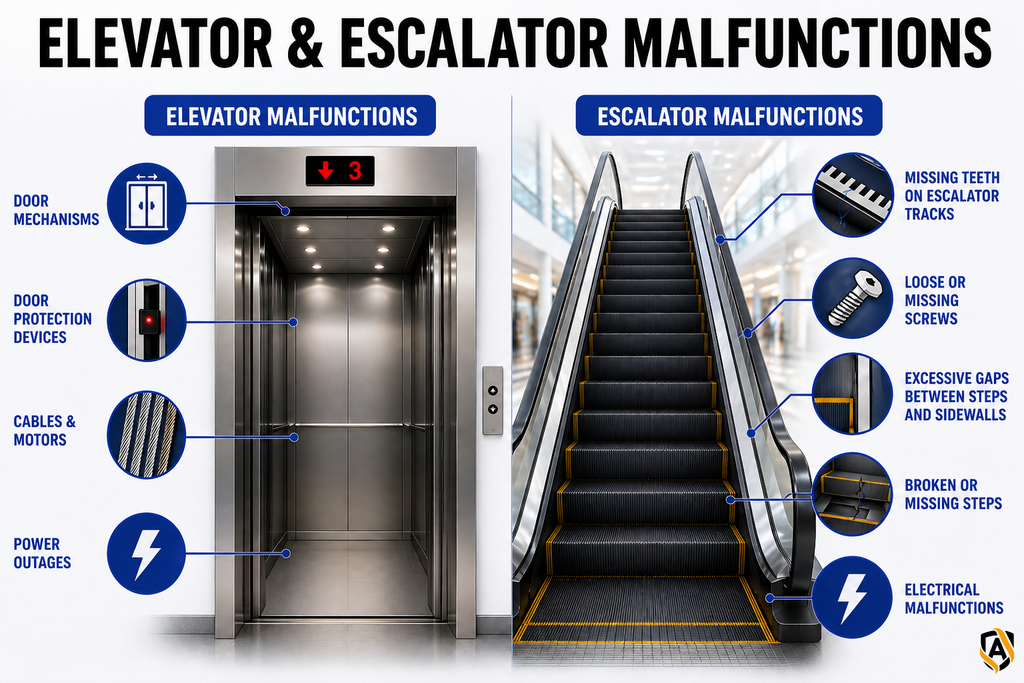
The leading cause of both elevator and escalator malfunctions is straightforward: failure to properly maintain high-use equipment. OSHA workplace safety regulations require thorough inspections at intervals not exceeding one year, yet maintenance failures continue to drive accident rates.
Elevator-specific problems frequently involve door mechanisms. Misaligned sensors, mechanical faults, and worn-out rollers cause doors to drag, stick, or fail to close completely. Door protection devices sometimes stop working, or closing force becomes improperly adjusted, creating entrapment hazards. Worn cables, broken motors, and power outages also contribute to elevator malfunctions that can trap passengers or create sudden drop scenarios.
Escalator defects present different but equally dangerous risks. Missing teeth on escalator tracks, loose or missing screws, and excessive gaps between steps and sidewalls all violate OSHA construction and maintenance safety standards. Broken or missing steps can cause trips and falls. Electrical malfunctions may cause sudden stops or jerky movements that throw riders off balance. Constant weight and usage contribute to wear on components, leading to misaligned tolerances and bent tracks that regular inspections sometimes fail to capture before accidents occur.
Who Is Most at Risk?
Between 1990 and 2005, approximately 29,000 children were hospitalized from escalator and elevator accidents nationwide. Half of the roughly 1,000 sidewall-entrapment injuries involved children under age five. Young children face particular vulnerability to entrapment injuries, which typically prove more severe than falls and can result in amputations or crushing injuries.
The elderly population faces equally serious risks. Between 1991 and 2005, 40,000 older adults sustained injuries in elevator and escalator incidents. Research shows that approximately 90 percent of all escalator incidents involve either senior citizens or small children. Adults 65 or older struggle with balance issues when getting on and off escalators due to differences in momentum between stationary floors and moving steps.
Seventy-five percent of escalator injuries result from falls, which pose particular danger for elderly individuals who may suffer hip fractures, head trauma, or spinal injuries. The remaining 20 percent involve entrapment between moving parts, affecting children disproportionately. Over half of all escalator-related injuries affect individuals under age 10 or over age 65.
Texas Legal Rights and Liability Framework
Texas premises liability law requires injured parties to prove four elements: duty of care, breach of that duty, causation, and damages. Shopping mall owners have a legal duty to maintain safe premises for all visitors, regardless of whether those visitors make purchases. When elevator or escalator malfunctions cause injuries, property owners may be held liable if they knew or should have known about dangerous conditions and failed to address them.
Multiple parties can potentially bear responsibility. Beyond property owners, liable parties may include business tenants who lease space, maintenance companies that performed faulty repairs or skipped inspections, equipment manufacturers, and elevator service companies. This expanded liability framework often provides injured parties with multiple avenues for compensation.
Texas follows a modified comparative negligence standard with a 51 percent bar rule codified in Texas Civil Practice and Remedies Code. Injured visitors can recover damages even if partially at fault, provided their percentage of fault does not exceed 50 percent. If victims bear some responsibility, their compensation is reduced proportionally. For example, someone deemed 20 percent at fault would receive 80 percent of total damages.
Recoverable damages can include medical expenses, rehabilitation costs, lost wages, future care needs, and pain and suffering. Compensation depends heavily on injury severity and specific circumstances, making documentation critical for maximizing recovery.
Warning Signs of Dangerous Equipment
Austin mall shoppers can take proactive steps to identify potentially dangerous elevators and escalators before use. OSHA regulations require that records of the latest annual inspection be posted visibly inside elevator cabs or in the vicinity of escalators. Missing or expired Certificates of Compliance serve as immediate red flags.
Physical signs of door problems include dragging, sticking, or failure to close fully. Doors that fail to align properly with landing floors indicate serious mechanical issues. Unusual sounds such as grinding, screeching, or jerky movements suggest worn components or inadequate maintenance.
Escalator-specific warning signs include visible gaps between steps and sidewalls, missing teeth on step surfaces, loose or missing screws, and broken or missing individual steps. Handrails that move too quickly, too slowly, or fail to move at all indicate malfunction. Any of these defects warrant using stairs or finding alternative equipment rather than risking injury.
Essential Safety Guidelines
General safety practices significantly reduce accident risk. Always face forward and maintain a firm grip on the handrail. Stand in the center of escalator steps rather than near edges. Ensure shoelaces are tied securely before boarding, as loose laces frequently cause entrapment injuries. Step off promptly at the end of the ride rather than hesitating.
Parents must take additional precautions with children. Always hold children's hands on escalators, and carry children under age five rather than allowing them to stand independently. Prohibit sitting or playing on escalator steps, as these behaviors dramatically increase injury risk. Watch carefully for loose clothing, drawstrings, scarves, and mittens that can become trapped in moving parts.
Elderly individuals and those with mobility challenges should pay particular attention to balance when getting on and off due to momentum differences. Maintain a firm grip on handrails throughout the ride. Do not board escalators with baby strollers, walkers, or bulky packages; use elevators for these items instead.
Know the location of emergency shutoff buttons, typically found at escalator entrances and exits, in accordance with Access Board safety guidelines. Research shows most accidents stem from carelessness during boarding and exiting rather than mechanical failures during the ride itself.
What to Do After an Accident
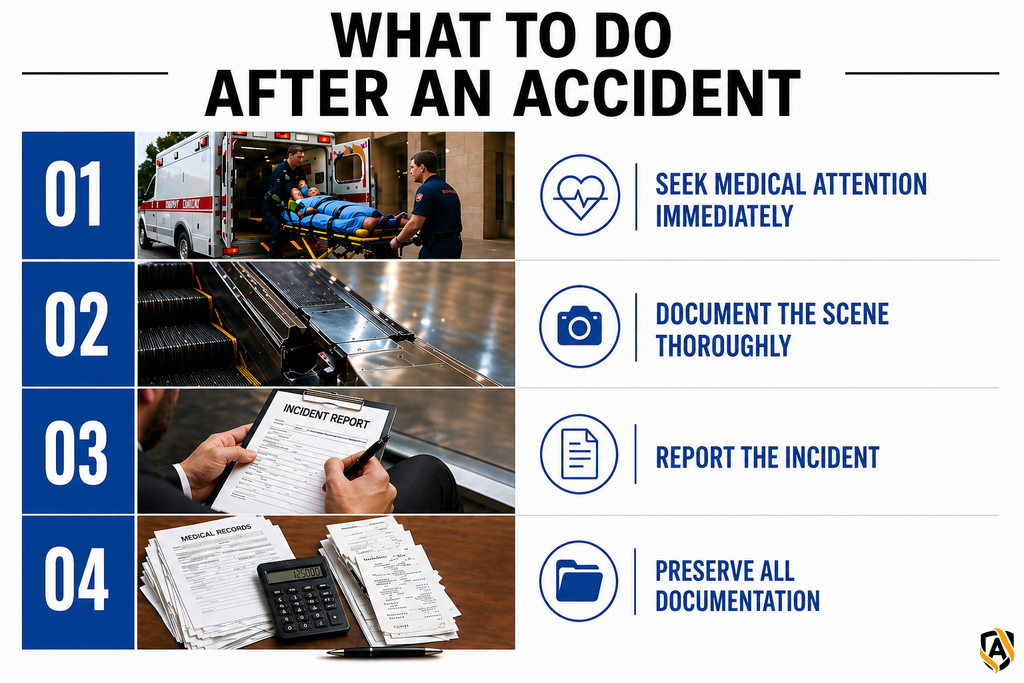
Seek medical attention immediately, even if injuries seem minor. Traumatic brain injuries, spinal cord damage, and internal organ injuries may not manifest symptoms right away. Professional medical evaluation creates essential documentation for any future legal claim.
Document the scene thoroughly. Photograph the equipment defect, noting any missing inspection certificates or expired compliance dates. Obtain contact information from witnesses who observed the accident. Note the absence of warning signs or visible safety violations.
Report the incident to mall management in writing and request a copy of the incident report. Ask for the equipment's recent inspection records and Certificate of Compliance. Building owners must maintain these documents under TDLR regulations.
Preserve all medical records, receipts, and documentation of lost wages or care needs. Do not sign liability waivers or accept settlement offers from property owners or insurance companies before consulting with a qualified attorney. Texas law provides a two-year statute of limitations for premises liability claims from the injury date, making prompt action important.
Conclusion
Austin mall elevators and escalators can pose serious dangers when property owners neglect maintenance obligations. Children under five and adults over 65 require extra vigilance due to heightened vulnerability. Recognizing warning signs before using equipment and following safety protocols significantly reduce injury risk. Texas premises liability law protects victims' rights to compensation when negligent property owners fail in their safety duties.
Frequently Asked Questions
How often are Austin mall elevators inspected under Texas law
Texas law requires building owners to obtain annual inspections for all elevators and escalators. The Certificate of Compliance remains valid for only one year and must be renewed annually. Electric traction elevators must undergo Category 5 full-load testing every five years per ASME Code requirements enforced by TDLR.
Can I recover damages if I was partially at fault for an escalator fall
Yes, under Texas modified comparative negligence law. You can recover compensation as long as your percentage of fault does not exceed 50 percent. If you are found 30 percent at fault, for example, your compensation would be reduced by 30 percent of the total damages awarded.
What is the most common cause of elevator door accidents in malls
Door malfunctions represent the most frequent elevator problem due to highly-used subsystems with many moving components. Specific causes include misaligned sensors, worn-out rollers, mechanical faults, and improperly adjusted door closing force. Lack of regular maintenance allows these issues to worsen until accidents occur.
Are escalators or elevators more dangerous in shopping centers
Elevators cause approximately 90 percent of deaths but only 60 percent of serious injuries. Escalators account for a higher percentage of total injuries, with 75 percent resulting from falls. However, the 20 percent of escalator injuries involving entrapment tend to be more severe, often resulting in amputations or crushing injuries.
Who can be held liable for elevator accidents in Austin malls
Multiple parties may bear legal responsibility including property owners, business tenants who lease mall space, maintenance companies that service equipment, elevator manufacturers, and service contractors. Texas premises liability law allows injured parties to pursue claims against any party whose negligence contributed to the accident.
About the Author

Aaron B Mickens
For over 25 years, Aaron has fought for justice on behalf of Austin's injured. He is committed to standing up to insurance companies and winning for clients across Central Texas.
View all articles by AaronNeed Legal Help?
Contact our experienced Austin personal injury attorneys for a free consultation.