Austin Rideshare Accidents: Who Pays When Your Uber/Lyft Driver Crashes on 6th Street?
It’s late on 6th Street, bars are closing, and you do the responsible thing — call an Uber or Lyft instead of driving yourself. A few blocks later, your driver blows a light or gets clipped by a speeding pickup, and suddenly you’re in the back seat of a wrecked car.
Now what? Who actually pays for your injuries? Your driver, Uber/Lyft, or the other car?
Why 6th Street crashes are different
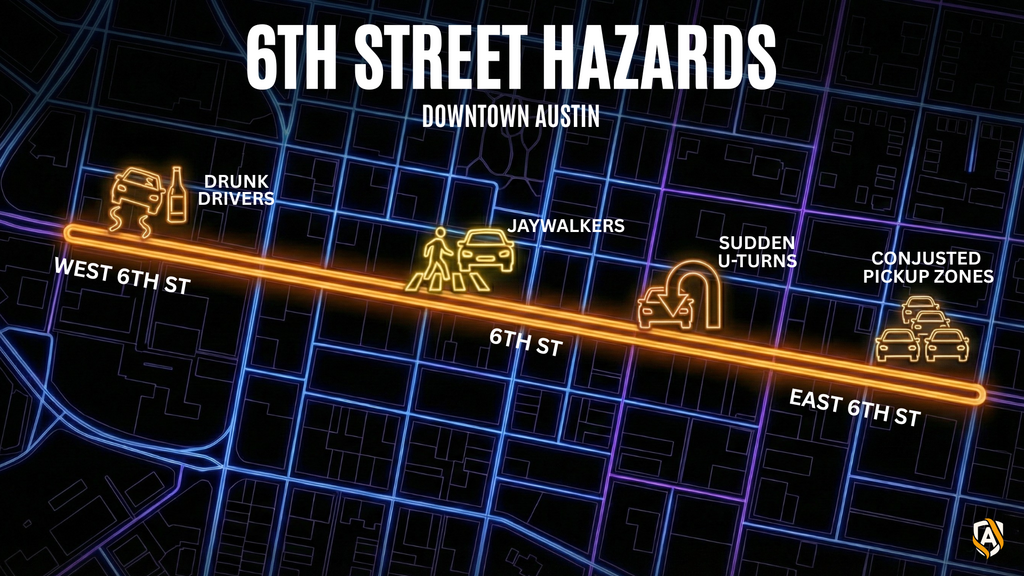
Downtown Austin, especially around East and West 6th, is a rough mix of heavy bar traffic, rideshare pickups, delivery drivers, and people crossing the street half-looking at their phones. APD has ramped up weekend DWI enforcement downtown because of the constant impaired-driving risk in this area.
Rideshare crashes here often involve:
- Drunk or distracted drivers (sometimes your driver, sometimes the other car)
- Congested pickup/drop-off zones
- Sudden stops, U-turns, and illegal double-parking
All of that affects who’s at fault and which insurance policy pays.
Texas Law basics: who’s on the hook?
Texas is a fault-based state. The driver (or drivers) who caused the crash are legally responsible for the damages. Medical bills, lost wages, pain and suffering, and so on.
If you’re a paying passenger in the back of an Uber or Lyft, you’re almost never blamed for causing the wreck. Your claim usually goes against:
- The rideshare driver’s insurance / Uber or Lyft’s policy (if your driver caused it), or
- The other driver’s insurance (if they caused it), and
- Sometimes both, plus uninsured/underinsured motorist (UM/UIM) coverage if someone doesn’t have enough insurance.
The big divider: Was the app on or off?
Your Lyft passenger injury rights in Texas, and your Uber passenger rights, turn on one simple detail: your driver’s app status at the time of the crash.
State law and Uber/Lyft policies break it into three phases.
1. App off (not working a ride)
If the driver is not logged into the Uber or Lyft app:
- This is not a rideshare trip in the eyes of the law.
- Only their personal auto insurance applies — usually at least the Texas minimums.
If a “rideshare driver” hits you on 6th Street but they were off the app and just driving home, your claim is treated like any other car wreck.
2. App on, waiting for a request (Period 1)
The driver is logged in and waiting for a ping, but you’re not in the car yet.
If they cause a crash in this phase, Texas law requires at least:
- $50,000 bodily injury per person
- $100,000 per accident
- $25,000 property damage
Uber and Lyft provide this as contingent coverage. It usually comes into play if the driver’s personal insurer denies or doesn’t have enough coverage.
This phase matters most if you’re in another car hit by a “between-rides” Uber/Lyft near 6th Street, or if you’re a pedestrian.
3. Ride accepted or passenger in the car (Periods 2 & 3)
This is the classic downtown scenario: you’ve requested an Uber/Lyft, the driver has accepted the ride, and you’re either:
- Being picked up on 6th, or
- Already riding toward home or your hotel.
Here, Uber and Lyft carry up to $1,000,000 in liability coverage for injuries and property damage per crash in Texas. They typically also include UM/UIM coverage if another driver with little or no insurance causes the wreck.
This is the coverage most Uber accident lawyer Austin ads are really talking about, the big policy that’s supposed to protect passengers and others during an active trip.
Who pays in common 6th Street rideshare crash scenarios?
Your Uber/Lyft driver caused the crash
Example: Your driver is weaving through traffic on West 6th to grab a better pickup spot and rear-ends another car.
If the app is active and you’re on a trip:
- Uber/Lyft’s $1M policy should be on the hook as primary coverage.
- Your damages can include medical bills, lost income, pain and suffering, and more.
Another driver hits your rideshare
Example: You’re in a Lyft on East 6th when a drunk driver runs a red light and smashes into your side.
- The at-fault driver’s insurance is primary.
- If that driver is uninsured or doesn’t have enough coverage, Uber/Lyft’s UM/UIM coverage can help fill the gap while you’re on an active ride.
Mixed fault and multiple cars
On 6th Street, it’s common for more than one driver to share blame, for example, your rideshare driver was speeding, but the other driver was drunk and ran the light.
In that case, your lawyer may pursue:
- The other driver’s policy
- Uber/Lyft’s $1M policy
- Any UM/UIM coverage that applies
Texas comparative fault rules decide how responsibility is split between drivers, but as a passenger, you’re still allowed to recover even if both drivers are partly at fault.
Lyft passenger injury rights in Texas (and Uber passengers too)
If you were hurt as a passenger, you have the right to:
- Get your medical bills, ER visit, follow-ups, and therapy covered
- Recover lost wages if you miss work
- Seek pain and suffering and other non-economic damages
- File claims against every policy that applies, your driver’s, the other driver’s, and the rideshare company’s insurance
You do not have to pick the “right” insurer on your own. One of the biggest jobs for an Uber accident lawyer in Austin is sorting out all the overlapping coverage and forcing each insurance company to pay its fair share.
What to do right after a 6th Street Uber/Lyft crash
What to do right after a 6th Street Uber/Lyft crash
If your ride ends in a collision, here’s a simple playbook:
- Call 911 and make sure APD comes out and writes a report.
- Screenshot your trip screen in the app (driver name, car, time, route).
- Get driver and vehicle info for every car involved.
- Take photos and short videos of the scene, damage, street signs, and anything that shows how the crash happened.
- Get checked out medically the same night if you feel anything at all. Dizziness, headache, soreness.
- Don’t give recorded statements or accept quick offers from any insurer until you’ve talked with a lawyer who handles rideshare cases.
Downtown rideshare crashes on 6th Street are messy because there are multiple insurers and shifting coverage rules. Knowing how app status, fault, and the $1M policies work is the first step to making sure you’re not the one left holding the bill.
Q1. What should I do right away if my Uber or Lyft crashes on 6th Street in Austin?
Call 911 so APD and EMS respond, then screenshot your trip screen in the app, get all driver and insurance details, take photos/video of the scene, damage, and injuries, and get checked out medically. Report the crash in the Uber/Lyft app, then talk to an injury lawyer before giving statements to insurers.
Q2. Who pays my medical bills after an Uber or Lyft accident in Austin?
Texas is a fault state, so the at-fault driver’s insurance is primary. As a passenger, you may also be covered by Uber or Lyft’s liability and uninsured/underinsured motorist policies during an active trip, plus your own health insurance and any MedPay/Personal Injury Protection you carry.
Q3. Does Uber or Lyft’s $1 million insurance cover me as a passenger in Texas?
Usually yes, if the ride has been accepted or is in progress. In Texas, once your driver accepts your trip or you’re in the car, Uber and Lyft must provide up to $1,000,000 in liability coverage, which generally protects injured passengers, other drivers, and pedestrians.
Q4. What if the other driver has no insurance or runs after hitting my rideshare?
If a hit-and-run driver or uninsured driver causes the crash while your Uber/Lyft trip is active, the companies’ uninsured/underinsured motorist (UM/UIM) coverage can step in, up to their policy limits. This can apply on top of, or instead of, the at-fault driver’s minimal coverage.
Q5. What are my rights as an injured Lyft or Uber passenger under Texas law?
You can pursue compensation for medical bills, lost wages, pain and suffering, and other losses from any at-fault party: your driver, another driver, or—through their policies—Uber or Lyft. Texas law requires TNCs to carry specific minimum coverages tied to the driver’s app status, which protect passengers and third parties.
Q6. How does the 51% rule affect an Uber or Lyft accident claim in Texas?
Texas uses modified comparative negligence. You can recover damages as long as you’re 50% or less at fault; if you’re 51% or more at fault, you recover nothing. As a passenger, you’re rarely assigned fault, but the rule still affects how much each driver or insurer ultimately pays.
Q1. What should I do right away if my Uber or Lyft crashes on 6th Street in Austin?
Call 911 so APD and EMS respond, then screenshot your trip screen in the app, get all driver and insurance details, take photos/video of the scene, damage, and injuries, and get checked out medically. Report the crash in the Uber/Lyft app, then talk to an injury lawyer before giving statements to insurers.
Q2. Who pays my medical bills after an Uber or Lyft accident in Austin?
Texas is a fault state, so the at-fault driver’s insurance is primary. As a passenger, you may also be covered by Uber or Lyft’s liability and uninsured/underinsured motorist policies during an active trip, plus your own health insurance and any MedPay/Personal Injury Protection you carry.
Q3. Does Uber or Lyft’s $1 million insurance cover me as a passenger in Texas?
Usually yes, if the ride has been accepted or is in progress. In Texas, once your driver accepts your trip or you’re in the car, Uber and Lyft must provide up to $1,000,000 in liability coverage, which generally protects injured passengers, other drivers, and pedestrians.
Q4. What if the other driver has no insurance or runs after hitting my rideshare?
If a hit-and-run driver or uninsured driver causes the crash while your Uber/Lyft trip is active, the companies’ uninsured/underinsured motorist (UM/UIM) coverage can step in, up to their policy limits. This can apply on top of, or instead of, the at-fault driver’s minimal coverage.
Q5. What are my rights as an injured Lyft or Uber passenger under Texas law?
You can pursue compensation for medical bills, lost wages, pain and suffering, and other losses from any at-fault party: your driver, another driver, or—through their policies—Uber or Lyft. Texas law requires TNCs to carry specific minimum coverages tied to the driver’s app status, which protect passengers and third parties.
Q6. How does the 51% rule affect an Uber or Lyft accident claim in Texas?
Texas uses modified comparative negligence. You can recover damages as long as you’re 50% or less at fault; if you’re 51% or more at fault, you recover nothing. As a passenger, you’re rarely assigned fault, but the rule still affects how much each driver or insurer ultimately pays.
About the Author

Aaron B Mickens
For over 25 years, Aaron has fought for justice on behalf of Austin's injured. He is committed to standing up to insurance companies and winning for clients across Central Texas.
View all articles by AaronNeed Legal Help?
Contact our experienced Austin personal injury attorneys for a free consultation.