How Fault Is Determined in Texas Car Accidents
If you have been in a car accident in Texas and are wondering how fault is figured out, this guide is for you. We will explain the basic rules Texas uses to decide who is responsible, how insurance companies look at evidence, and what mistakes to avoid while the claim is being reviewed.
What Fault Means Under Texas Law
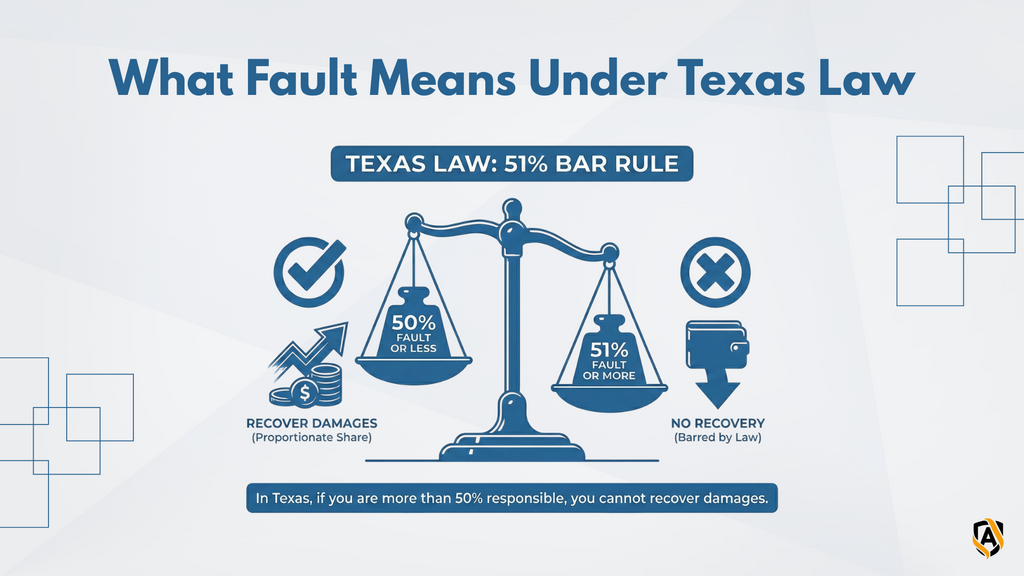
In Texas, car accident fault is based on a rule called proportionate responsibility. This means each driver can be assigned a percentage of fault for the crash.
If your share of fault is 50 percent or less, you can usually pursue compensation. If you are 51 percent or more at fault, you are not allowed to recover damages from the other driver under Texas Civil Practice and Remedies Code Section 33.001.
If your share of fault is 50 percent or less, you can usually pursue compensation. If you are 51 percent or more at fault, you are not allowed to recover damages from the other driver under Texas Civil Practice and Remedies Code Section 33.001.
Think of it like splitting a restaurant bill. If one person caused most of the problems, they carry most of the responsibility. If both people contributed, the responsibility can be divided.
How Fault Is Usually Investigated
Insurance companies and, in some cases, police officers gather information and then decide who is responsible. Here are the common pieces of evidence they look at.
- Police reports, including officer opinions and any citations issued.
- Photos and videos from the scene.
- Statements from drivers and passengers.
- Witness statements.
- Skid marks, vehicle damage patterns and debris locations.
- Traffic laws that apply to the situation, for example failure to yield or running a red light.
Each insurance adjuster may weigh evidence differently. This is one reason two companies involved in the same crash can reach different conclusions.
Common Situations That Affect Fault
Certain facts often play a strong role in how fault is assigned in Texas.
- Rear end collisions. The driver in the back is usually considered at fault unless there is clear proof of something unusual.
- Left turn crashes. The turning driver is often responsible because they must wait until it is safe to turn.
- Distracted driving. Texting, adjusting navigation or eating can all increase a driver’s share of responsibility.
- Speeding. Even going slightly over the limit can change how fault is calculated.
- Unsafe lane changes. Swerving without signaling or checking mirrors can lead to partial or full responsibility.
Common Mistakes People Make After a Texas Accident
These problems can make it harder to show what actually happened.
- Not calling the police. A police report often becomes important evidence.
- Not taking photos. Pictures help show positions of vehicles and road conditions.
- Admitting fault too early. Even a simple apology can be misunderstood.
- Waiting too long to report the claim. Insurance companies may question delays.
- Ignoring medical care. Gaps in treatment can raise questions about injuries.
When It Is Helpful to Talk to a Texas Car Accident Lawyer
Speaking with a lawyer can be helpful if:
- The insurance companies disagree about who is at fault.
- You are being blamed for more than you believe is fair.
- Injuries are serious or long lasting.
- A commercial vehicle or rideshare driver is involved.
- There is very little evidence and you need help gathering more.
A lawyer can help explain your rights, deal with insurance adjusters and review how Texas fault rules apply to your situation.
Conclusion
Texas uses a shared fault system that divides responsibility between drivers, and your ability to recover money depends on your percentage of fault. Evidence such as police reports, photos and witness statements plays a big role in the decision. If there is confusion or disagreement about what happened, talking to a lawyer can help you understand your options.
FAQ Section
How do insurance companies decide who was at fault in a Texas crash
Insurance companies look at police reports, photos, statements and traffic laws to decide responsibility. They usually assign a percentage of fault to each driver. If the evidence is unclear, they may talk to witnesses or request more documentation before making a decision.
Insurance companies look at police reports, photos, statements and traffic laws to decide responsibility. They usually assign a percentage of fault to each driver. If the evidence is unclear, they may talk to witnesses or request more documentation before making a decision.
Can more than one driver be at fault in Texas
Yes, Texas uses a shared fault system. Each driver can be given a percentage of fault that adds up to one hundred percent. This matters because your compensation can be reduced by your percentage of responsibility.
What if the police officer got the accident details wrong
You can request a correction or add your own written statement to the report. Insurance companies do not have to follow the report exactly, but officers’ observations often influence their decisions.
What if the other driver lies about the crash
If the other driver gives false information, evidence such as photos, video, damage patterns and witness statements usually helps uncover the truth. You can also provide your own written statement to the insurance company.
If the other driver gives false information, evidence such as photos, video, damage patterns and witness statements usually helps uncover the truth. You can also provide your own written statement to the insurance company.
How does Texas handle hit and run accidents
If the other driver leaves the scene, you can still file a claim through your own uninsured motorist coverage if you have it. Evidence such as photos, debris and witness information becomes especially important in these cases.
If the other driver leaves the scene, you can still file a claim through your own uninsured motorist coverage if you have it. Evidence such as photos, debris and witness information becomes especially important in these cases.
About the Author

Aaron B Mickens
For over 25 years, Aaron has fought for justice on behalf of Austin's injured. He is committed to standing up to insurance companies and winning for clients across Central Texas.
View all articles by AaronNeed Legal Help?
Contact our experienced Austin personal injury attorneys for a free consultation.