Navigating I-35 Construction Zones: Liability When Roadwork Causes Crashes
I-35 through Austin is a construction zone for years to come. TxDOT’s I-35 Capital Express projects (North, Central, and South) are reshaping the highway from SH 45 North to SH 45 Southeast with lane shifts, narrowed frontage roads, new ramps, and long-term closures.
That kind of upheaval has a cost. In 2024 alone, Texas saw nearly 28,000 work-zone crashes and 215 deaths, a double-digit increase over the year before. Many of those wrecks look a lot like what we see on I-35 in Austin: sudden slowdowns, confusing signs, missing barrels, and debris in the lane.
If you’re hit in one of these zones and you’re Googling “construction zone accident lawyer Austin” or “I-35 crash construction liability,” you’re really trying to answer one question: Who can I actually hold responsible?
Why I-35 Construction Zones Are So Dangerous Right Now
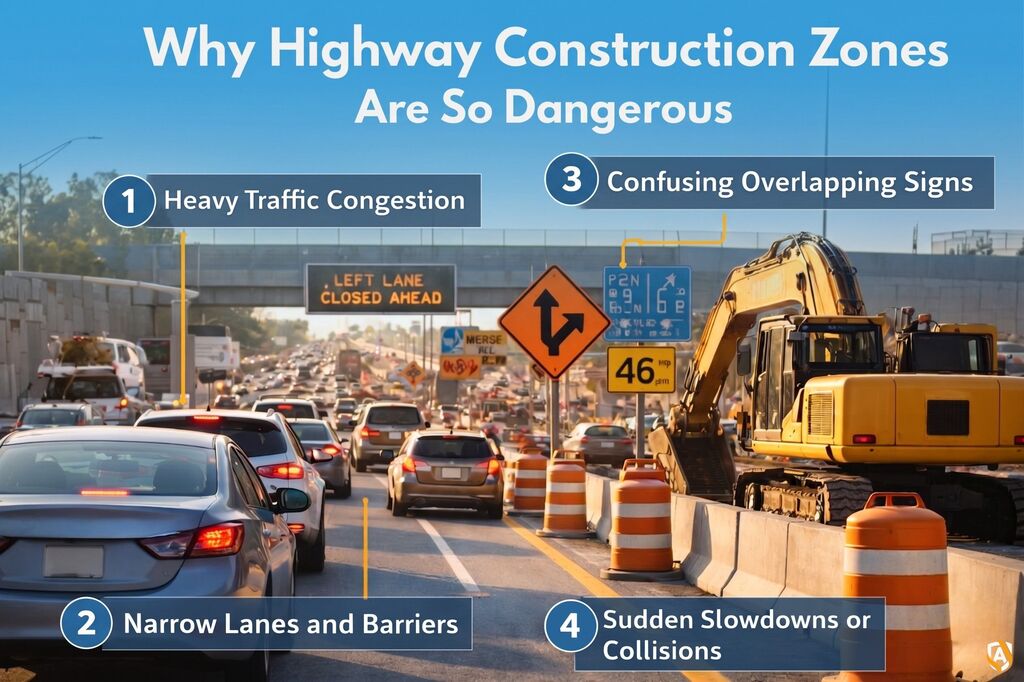
A few factors combine to make I-35 work zones uniquely risky:
- Constant lane shifts and narrow lanes. The Capital Express projects squeeze frontage roads to one lane in spots and push traffic next to concrete barriers for miles.
- Heavy congestion mixed with highway speeds. Rear-end collisions are the number-one type of crash in Texas work zones. Drivers come around a curve or over a rise and suddenly hit stopped traffic.
- Complicated detours and signage. When message boards, lane-closure signs, and barrels don’t match what’s really happening on the pavement, drivers make last-second moves.
- Debris and work vehicles. Construction equipment, loose gravel, and materials left too close to live lanes give you less room and less time to react.
All of that matters when you’re trying to sort out who’s on the hook for your injuries.
Who Can Be Liable After an I-35 Construction-Zone Crash?
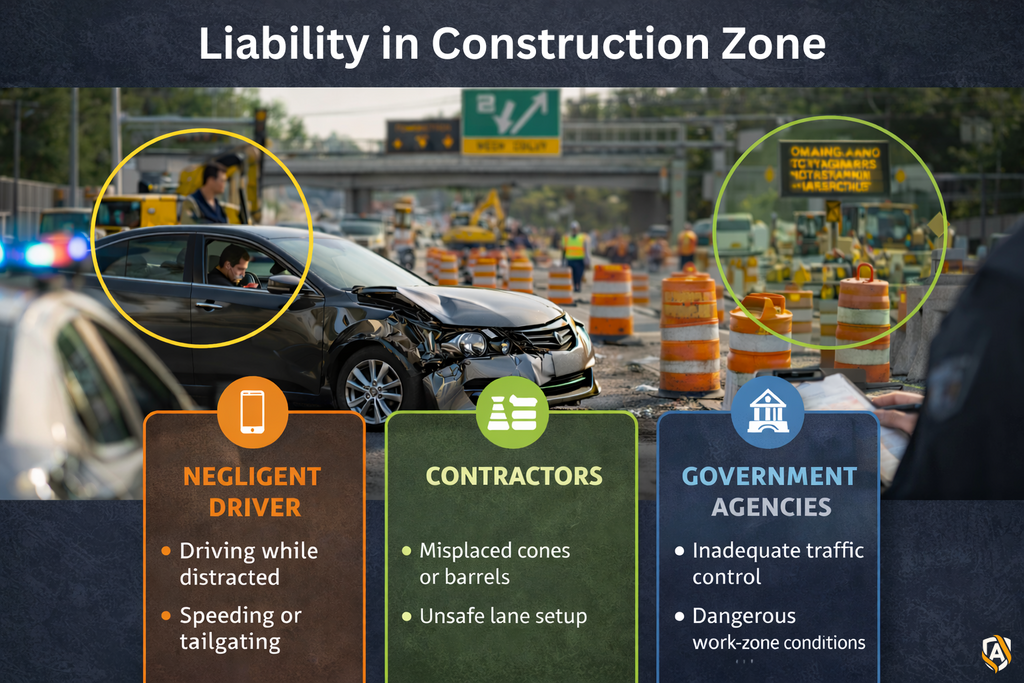
1. Other Drivers
Most work-zone cases still come down to another driver’s negligence. Common problems:
- Speeding through the zone despite reduced limits
- Tailgating or failing to brake in time
- Texting or looking at GPS instead of the road
- Making sudden lane changes around barrels or trucks
In a typical rear-end crash or unsafe lane change, the at-fault driver (and their insurer) is the primary target. Work-zone or not, Texas is still an at-fault state: the negligent driver pays.
2. Construction Companies and Subcontractors
When the work zone itself is part of the problem, you may have a claim against the construction company or traffic-control subcontractor. That’s where I-35 crash construction liability gets more complex.
Contractors can be liable when they:
- Ignore TxDOT-approved traffic control plans
- Fail to post advance warning signs in time
- Place cones or barrels in ways that confuse drivers
- Leave equipment, barriers, or debris in live lanes
- Create severe drop-offs, uneven pavement, or sudden lane shifts without proper warnings
Texas injury lawyers handling construction-zone cases often dig into traffic-control plans, daily work logs, and TxDOT inspection records to see if the contractor followed the rules.
If the contractor didn’t follow the plan or violated safety standards, they may share fault with the other driver, or even be the primary cause of the wreck.
3. Government Entities (TxDOT, City of Austin)
Suing TxDOT or the City of Austin adds another layer: sovereign immunity. Under the Texas Tort Claims Act, you can only sue a government entity in limited situations and within strict damage caps.
The Texas Supreme Court recently reaffirmed how tough this can be in a 2023 case where crash victims sued TxDOT over a construction-zone condition. The Court threw the case out, holding they hadn’t shown an “unreasonably dangerous condition” that fit the narrow waiver of immunity.
Bottom line:
- You might have a claim against TxDOT or a city if a dangerous work-zone condition qualifies under the Tort Claims Act.
- These claims are complex, strongly defended, and very fact-specific.
In many I-35 cases, the more realistic targets are the at-fault driver and the private contractors, not TxDOT itself.
How Fault Is Split in a Construction-Zone Wreck
How Fault Is Split in a Construction-Zone Wreck
Texas uses modified comparative negligence. Everyone’s percentage of fault is weighed. Other drivers, contractors, sometimes government entities, and yes, sometimes you.
Key points:
- You can still recover damages if you are 50% or less at fault.
- If you’re 51% or more at fault, you recover nothing.
- Your total compensation is reduced by your percentage of fault.
So if a jury finds:
- Other driver: 60%
- Contractor: 25%
- You: 15%
You can still recover, but your award is cut by that 15%.
In construction-zone cases, insurers and defense lawyers will often try to push more blame onto you. “You were speeding,” “you ignored the signs,” “you followed too closely”, to get you to or past that 51% line.
Building an I-35 Construction-Zone Liability Case
Building an I-35 Construction-Zone Liability Case
If you’re in a crash on I-35 while roadwork is going on, evidence disappears fast. Here’s what helps:
- Scene photos and video. Get the barrels, signs, lane markings, message boards, and any debris in the frame, not just the vehicles.
- Dashcam and phone video. Save copies before anything auto-deletes.
- Witness information. Other drivers may have seen confusing signs, sudden lane drops, or equipment sticking into the lane.
- Official reports and logs. A lawyer can request crash reports, lane-closure logs, traffic-control plans, and any prior complaints about that stretch of I-35.
If you’re searching for a construction zone accident lawyer Austin drivers trust, look for someone who has actually handled highway work-zone and I-35 cases. These aren’t routine fender-benders. You need someone comfortable with TxDOT plans, contractor records, and the Texas Tort Claims Act, not just the police report.
The short version:
- Yes, you can often go beyond the other driver and look at contractors and, in some cases, public entities.
- No, it is not simple. Work-zone crashes on I-35 are technical, evidence-heavy cases where every detail of how that work zone was set up can make or break your claim.
About the Author
Aaron B Mickens
For over 25 years, Aaron has fought for justice on behalf of Austin's injured. He is committed to standing up to insurance companies and winning for clients across Central Texas.
View all articles by AaronNeed Legal Help?
Contact our experienced Austin personal injury attorneys for a free consultation.