The Most Dangerous Intersections in Austin: A 2025 Safety Analysis
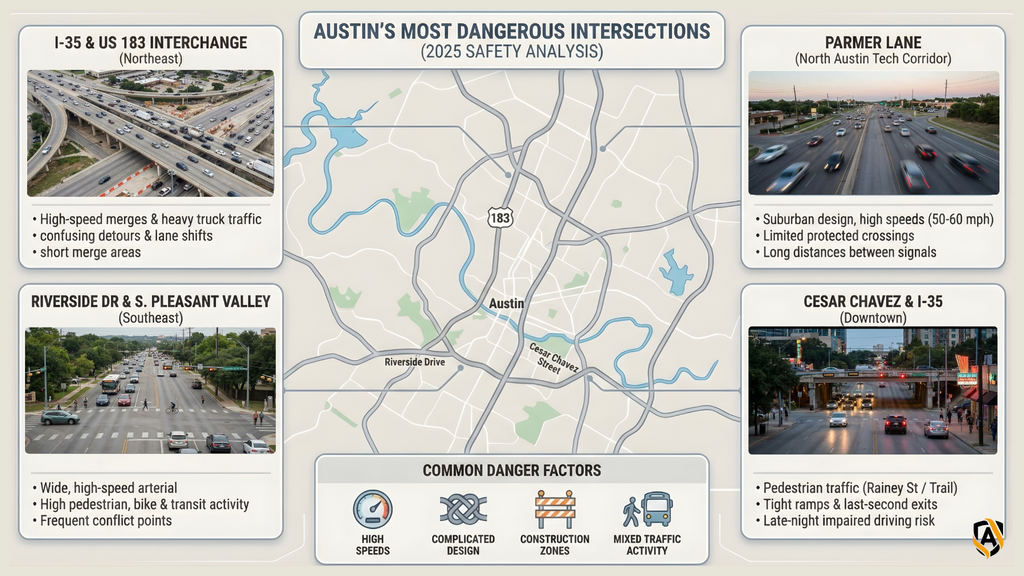
If you spend much time driving across Austin, you already know where your stomach tightens a little: I-35, Riverside, Cesar Chavez, Parmer, and the big interchanges in North Austin. In 2025, those gut feelings are backed up by hard crash data from TxDOT and the City’s Vision Zero program.
So far in 2025, Austin has already passed 80 roadway deaths, with Vision Zero noting that fatal crashes are up compared with last year, even as serious-injury crashes trend downward.
Many of those deaths cluster on a short list of dangerous roads in Austin, especially along I-35, Riverside Drive, Cesar Chavez, and Parmer Lane.
I-35: From Riverside to US 183: Austin’s Most Dangerous Spine
Multiple studies now rank Austin’s I-35 among the deadliest roads in the country and the second-deadliest in Texas.
TxDOT data show at least 2,300 crashes every year on the I-35 stretch in and around Austin, with an average of about 23 people killed annually since 2020.
Accidents at I-35 and US 183
Even after a $124-million flyover and connector upgrade, the I-35 and US 183 interchange is still a major trouble spot. TxDOT itself called it one of the state’s worst chokepoints before the rebuild, thanks to heavy truck traffic, weaving movements, and short merge areas.
Recent crashes underscore that risk. A fatal collision between a semi and a pickup in the 8200 block of I-35 northbound near US 183 shut down lanes in late 2023.
In July 2025, a pedestrian was struck and later died on the I-35 northbound service road between US 183 and Rutherford Lane.
Construction tied to the I-35 Capital Express North project, lane shifts, night closures, confusing detours between US 183 and Rundberg, puts extra stress on drivers already dealing with congestion.
When you mix that with high speeds and distracted driving, the margin for error at this interchange gets very thin.
Riverside Drive Crash Statistics: A High-Injury East-West Corridor
East Riverside Drive has become one of Austin’s classic high-injury corridors. Vision Zero lists the stretch around Riverside and South Pleasant Valley as one of just 13 “High-Injury Roadways” where more than 350 people have been seriously hurt or killed in the past five years.
2025 has kept that pattern going:
In April, a crash between a pickup and motorcycle at East Riverside and South Pleasant Valley added another death to the tally.
In November, Austin police reported a fatal crash near East Riverside by Royal Crest and Burton, and reports later noted this as part of the city’s 80-plus fatal crashes this year.
Why is Riverside so dangerous?
Six or more lanes in some segments, with high posted speeds.
Heavy apartment and student housing density, meaning lots of people walking, biking, and catching buses.
Frequent driveways, side streets, and turn pockets, which create constant conflict points.
Ongoing mobility and safety projects that shift lanes and add new medians and signals, which can confuse drivers who “know this road” and are not watching closely.
If you are looking up Riverside Drive crash statistics, what you are really seeing is the story of a fast, wide road that has been used like a highway in the middle of a dense, growing neighborhood.
Cesar Chavez and I-35: Downtown’s Risky Crossroads
Downtown, Cesar Chavez Street and the I-35 frontage roads form another serious hot zone. Safety studies have long flagged Cesar Chavez and I-35 as one of Austin’s most dangerous intersections, especially because of high speeds on the frontage road combined with heavy pedestrian traffic headed to bars, the lakefront, and downtown hotels.
In 2025, that pattern kept showing up in the incident logs:
A crash with injuries was reported along East Cesar Chavez near the I-35 northbound lanes in April.
In November, a box truck rollover on I-35 near Cesar Chavez shut down southbound lanes and caused major delays as traffic was diverted to the Riverside exit and frontage roads.
The ingredients here are familiar: tight ramp spacing, drivers darting across multiple lanes to make last-second exits, pedestrians crossing to and from Rainey Street and the hike-and-bike trail, and a lot of late-night impaired driving.
Parmer Lane and North Austin: Fast Traffic Meets Suburban Design
Farther north, Parmer Lane has become one of the clearest examples of how a suburban arterial can behave like a freeway, and crash like one, too. Vision Zero maps show Parmer as part of the city’s High-Injury Network, with a concentration of serious crashes near tech campuses and apartment clusters.
The 500–800 blocks of West Parmer Lane have seen multiple deadly crashes in 2025 alone, including pedestrian and vehicle fatalities that closed the road in both directions.
A February crash near West Parmer and McNeil Drive ejected several people from their vehicles.
Why Parmer stands out:
Four to six lanes of high-speed traffic serving major employers like Apple and other tech firms.
Limited protected crossings for people on foot or bike.
Dark segments and long distances between signals, which encourage speeding.
When people talk about dangerous roads in Austin, Parmer is now in that conversation right alongside I-35 and Riverside.
What Makes These Spots So Dangerous?
Looking across the data, several themes keep showing up on these corridors and intersections:
High speeds on wide roads I-35, Parmer, and Riverside are all built for fast travel, but they run through areas packed with homes, jobs, and nightlife.
Complicated designs multi-lane frontage roads, short ramps, and tight merges at places like I-35/US 183 and I-35/Cesar Chavez leave very little time to correct a mistake.
Construction and lane shifts the I-35 Capital Express projects and corridor improvements on Riverside add cones, barriers, and sudden lane changes that punish inattention.
High pedestrian and transit activity East Riverside, Cesar Chavez and Pleasant Valley, and parts of North Lamar and Rundberg all combine fast traffic with people walking to bus stops, stores, and schools.
How to Protect Yourself at Austin’s Most Dangerous Intersections
You cannot fix roadway design from behind the wheel, but you can adjust how you drive on these corridors:
Dial the speed back on I-35, Parmer, and Riverside, especially at night or in bad weather. Speed is still a leading factor in Texas traffic deaths.
Avoid last-second lane changes near big interchanges like I-35 and US 183 or downtown exits. If you miss your exit, take the next one.
Treat Riverside and Cesar Chavez like city streets, not freeways. Expect pedestrians to be there, even late.
Give trucks extra space on I-35. Many of the worst crashes near Parmer, US 183, and downtown involve heavy commercial vehicles.
Austin has made real progress reducing serious-injury crashes where it has redesigned streets, but 2025 shows the job is far from finished. If you spend time around I-35 and US 183, along Riverside Drive, or on Cesar Chavez and Parmer Lane, that awareness, and a little extra patience, can literally be lifesaving.
For over 25 years, Aaron has fought for justice on behalf of Austin's injured. He is committed to standing up to insurance companies and winning for clients across Central Texas.