Propeller Strike Injuries: Legal Rights & Compensation
The U.S. Coast Guard reported 169 propeller strike incidents in 2023 resulting in 30 deaths and 158 injuries. These devastating accidents carry a 15-17% fatality rate with similar amputation rates. Coast Guard data suggests up to 90% of non-fatal injuries go unreported.
Victims face catastrophic consequences with medical costs frequently exceeding $100,000 and permanent disabilities. Multiple parties may share liability, including operators, manufacturers, owners, and rental companies.
Understanding Propeller Strike Injuries
Propeller strikes create distinctive injury patterns involving multiple deep parallel lacerations causing permanent scarring, blood loss, amputation, or death. Between 2009-2016, 257 of 1,397 documented injuries resulted in amputation.
Studies show 46% of patients develop infections from water-borne bacteria forced into wounds. Victims average 2.8 surgical procedures during initial hospitalization. Medical analysis reveals 59.3% of fractures are Gustilo-Anderson Type IIIA or greater—the most severe category. Complications include stiffness, non-union fractures, and flap failure.
How Propeller Strike Accidents Happen
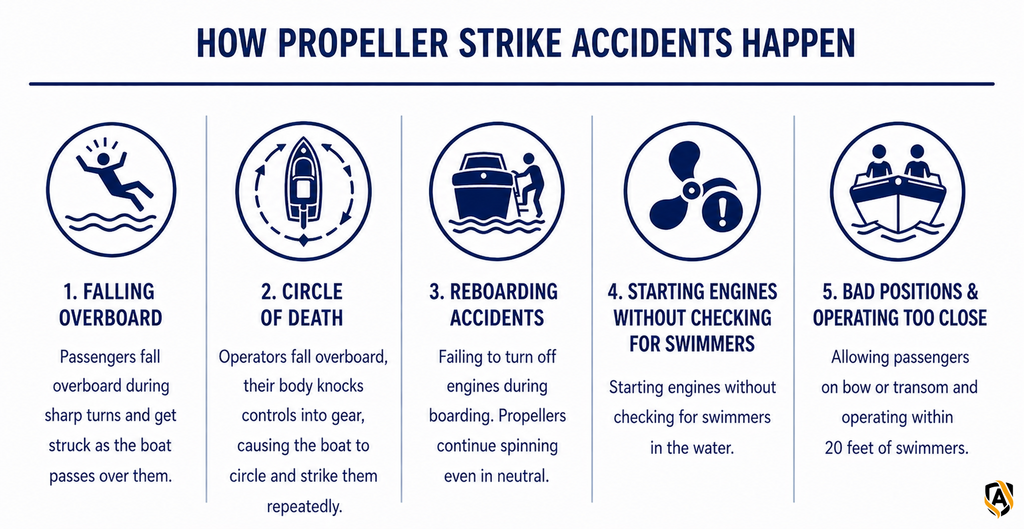
Most strikes follow predictable negligence patterns. Passengers fall overboard during sharp turns from bowrider and pontoon boats, then get struck as the boat passes over them. The "Circle of Death" phenomenon occurs when operators fall overboard and their body knocks controls into gear, causing the boat to circle and strike them repeatedly.
Reboarding accidents happen when operators fail to turn off engines completely during passenger boarding. Propellers continue spinning even in neutral. Other scenarios include starting engines without checking for swimmers, allowing passengers on bow or transom positions, and operating within 20 feet of swimmers. Most accidents occur on 16-25 foot open motorboats.
Federal and State Safety Regulations
No federal law requires propeller guards on most recreational boats. However, the National Defense Authorization Act of 2021 established mandatory Engine Cut-Off Switch (ECOS) requirements effective April 1, 2021.
Federal law requires ECOS use on recreational vessels under 26 feet when operating on plane or above displacement speed, with exceptions for docking, launching, and trolling. Texas enacted "Kali's Law" requiring kill switch use above headway speed. Failure to comply can result in $100 civil penalties and serves as negligence evidence. The American Boat & Yacht Council (ABYC) develops voluntary standards followed by 90%+ of U.S. manufacturers.
Proving Operator Negligence
Operator failure to follow navigation rules contributed to 56% of boating accidents in 2023. Seventy-five percent of deaths occurred where operators received no boating safety instruction. BUI is the primary factor in 17% of fatalities, with alcohol contributing to 35% of all boating fatalities. The 0.08% BAC limit applies.
Common negligence includes excessive speeding, failing to maintain lookout, inattention, and inexperience. Plaintiffs must prove the operator owed a duty to operate safely, breached that duty, and directly caused injuries. Maritime law applies comparative negligence—victims partially at fault have compensation reduced by their responsibility percentage but can still recover.
Multiple Parties Who Can Be Held Liable
Propeller strike litigation often involves multiple defendants. Operators face liability for BUI, excessive speed, and navigation rule violations. Owners bear responsibility when maintenance failures cause accidents, even if someone else operated the vessel.
Manufacturers face strict liability for design defects, manufacturing defects, and inadequate warnings. A California case against MasterCraft resulted in $30 million (manufacturer 80% at fault) for defective design. Young Ryan Batchelder died after washing from a Malibu Response LX bow seat when it swamped, sweeping him into the propeller.
Rental companies face liability for renting to unqualified operators, failing to provide safety equipment or instructions, and poor maintenance. Florida law requires rental companies to inform customers of safety rules. Maritime law's unseaworthiness doctrine holds owners responsible for ensuring vessels are safe regardless of knowledge of specific defects.
Damages and Compensation You Can Recover
Victims pursue multiple damage categories. Medical expenses include emergency treatment, surgery, rehabilitation, and future care, often exceeding $100,000. Lost income encompasses past earnings and future capacity for those with permanent disabilities.
Pain and suffering addresses physical pain, emotional trauma, disfigurement, and diminished quality of life. Gross negligence or BUI cases may warrant punitive damages. One case involving a child fatally struck while snorkeling settled for $1.7 million within one year. Catastrophic injuries frequently exceed $500,000 to several million. Wrongful death settlements typically range $500,000 to over $3 million.
Prevention and Safety Best Practices
Before starting engines, walk to the stern and check water for swimmers near the propeller. Never start with engine in gear. Turn off engines completely when passengers board or disembark—never leave idling.
Assign adults to report head counts before starting motors. Never permit passengers on bow, gunwale, or transom. When retrieving someone from water, turn bow toward them and shift to neutral one boat-length away. Never reverse to pick up swimmers.
Wear ECOS lanyards at all times when underway. Maintain 200+ foot distance from swimming areas. Never release the steering wheel until completely stopped to prevent Circle of Death accidents.
Take Action to Protect Your Rights
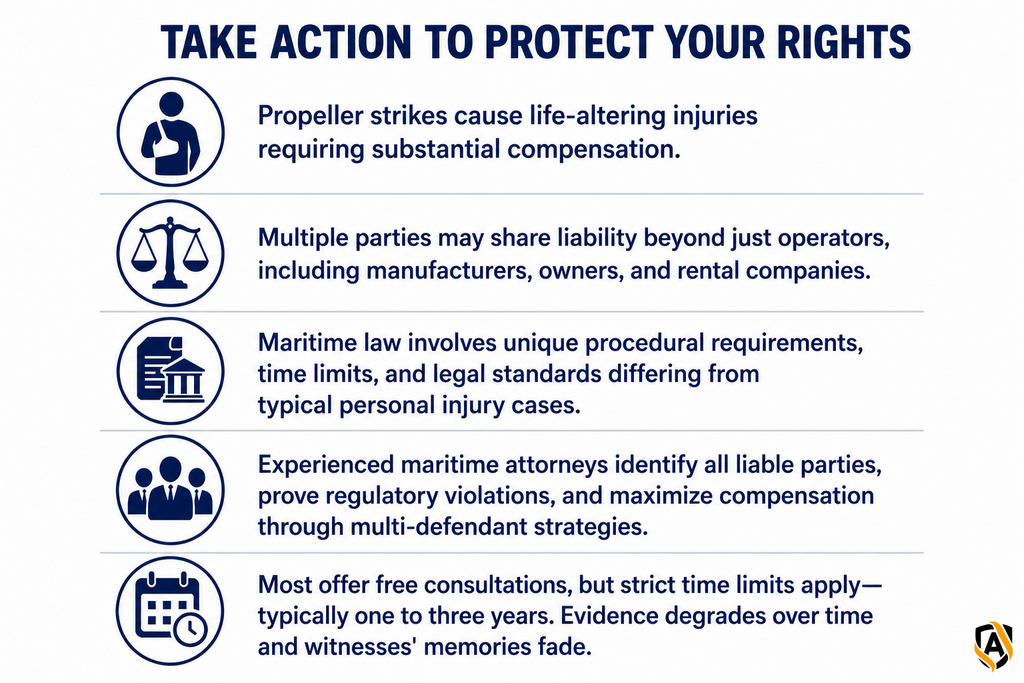
Propeller strikes cause life-altering injuries requiring substantial compensation. Multiple parties may share liability beyond just operators, including manufacturers, owners, and rental companies. Maritime law involves unique procedural requirements, time limits, and legal standards differing from typical personal injury cases.
Experienced maritime attorneys identify all liable parties, prove regulatory violations, and maximize compensation through multi-defendant strategies. Most offer free consultations, but strict time limits apply—typically one to three years. Evidence degrades over time and witnesses' memories fade. Contact a maritime personal injury attorney immediately to preserve your rights and begin pursuing compensation.
Frequently Asked Questions
How long do I have to file a propeller strike injury lawsuit?
Maritime personal injury claims typically allow three years from injury date, though this varies by state. Claims against government entities often require formal notice within six months. Some states have shorter statutes of limitations (one to two years). These deadlines are strict—missing them permanently bars claims. Consult an attorney immediately after accidents to preserve critical evidence and witness testimony.
Can I sue a boat rental company for a propeller strike injury?
Yes. Boat rental companies can be held liable for renting to unqualified operators, providing defective safety equipment, and failing to provide adequate instructions. Florida law specifically requires rental companies to inform customers of boating safety rules. Rental companies typically carry substantial commercial liability insurance, making them viable defendants even when operators have limited assets.
What if I was partially at fault for the propeller strike accident?
Comparative negligence applies under maritime law—partial fault doesn't bar recovery in most jurisdictions. Compensation reduces by your fault percentage. If 30% at fault, you recover 70% of damages. Defendants routinely claim comparative fault to reduce payouts. Experienced legal representation is essential to minimize your assigned fault percentage and maximize recovery.
What if the boat operator was a friend or family member?
You can still pursue compensation since most claims are paid by insurance, not personal assets. Homeowner's and boat liability insurance exist specifically for these situations. Many states require boat liability insurance. Not pursuing claims may leave you unable to pay substantial medical bills and ongoing care costs. Ethical maritime attorneys handle these sensitive situations professionally.
Do propeller strike cases require going to court?
Most cases settle before trial. Insurance companies avoid jury trials because juries sympathize with severely injured victims, especially with obvious safety violations or BUI. Cases with clear liability often settle through mediation or negotiations. Your attorney handles all filings and negotiations. Trials occur only when offers are unreasonably low. The $30 million MasterCraft verdict demonstrates trial outcomes can substantially exceed settlement offers.
About the Author

Aaron B Mickens
For over 25 years, Aaron has fought for justice on behalf of Austin's injured. He is committed to standing up to insurance companies and winning for clients across Central Texas.
View all articles by AaronNeed Legal Help?
Contact our experienced Austin personal injury attorneys for a free consultation.