
City Liability for Biker Pothole Injuries: Legal Guide
Cyclist fatalities in the United States reached a staggering 1,166 deaths in 2024, representing an 87% increase since 2010. While road debris and pothole injuries are common, many injured cyclists remain unaware of their legal rights or the critical filing deadlines that can permanently bar recovery. Municipal liability exists for poorly maintained roads, but governmental immunity creates significant barriers to successful claims.
Understanding your state's specific notice requirements, filing deadlines, and damage caps is essential before these narrow windows expire. Recent court rulings demonstrate dramatically different approaches to cyclist protection, with some states restricting liability while others expand municipal accountability. This guide provides a state-specific roadmap to evaluate your claim viability and preserve your legal rights.
Understanding Municipal Immunity: When Cities Can't Be Sued
Governmental immunity protects municipalities in many tort lawsuits, though this protection differs from the absolute sovereign immunity states enjoy. The critical distinction lies between discretionary functions-policy planning decisions that receive immunity-and ministerial functions like road maintenance implementation that do not.
Municipalities owe a duty to maintain roadways in reasonably safe condition for ordinary travel. However, the standard is reasonableness, not perfection. Cities aren't liable for conditions affecting only negligent drivers or for policy-level decisions about resource allocation.
The "willful and wanton conduct" exception provides a pathway to overcome immunity. When municipalities demonstrate reckless disregard for safety-such as ignoring repeated complaints about a hazardous pothole-they can be held liable even when immunity would otherwise apply.
The Notice Requirement: Proving the City Knew
Proving the municipality had prior notice represents the most critical element in pothole claims. Actual notice occurs when the city is directly informed through complaints, work orders, or employee observations. Constructive notice applies when a defect is so obvious and has existed long enough that the city should have discovered it with reasonable care.
Most courts consider six to eight weeks a reasonable timeframe for discovery during regular inspections. The pothole must have been discoverable, existed sufficient time to allow repairs, and posed an obvious danger if left unaddressed.
New York City's prior written notice statute eliminates the constructive notice doctrine entirely, requiring specific written complaints. California and Ohio accept constructive notice without written documentation requirements. Understanding your jurisdiction's notice standard determines whether you can prove this essential element.
State-by-State Variations: Critical Deadlines and Caps
Filing deadlines vary dramatically by state, ranging from 30 days to six months for notice of claim submission. New Jersey requires 90-day notice to public entities, California allows six months under its Tort Claims Act, while New York mandates 90 days for notice followed by one year and 90 days for the actual lawsuit.
"Reasonable repair time" standards also differ substantially. Taunton, Massachusetts requires repairs within 72 hours of receiving notice, Michigan statute defines reasonable time as 30 days or longer, and New York authorities must have been notified at least 15 days prior to damage for potential liability.
Damage caps significantly limit recovery in many states. Texas caps city liability at $250,000 per person and $500,000 per occurrence. Massachusetts imposes a $100,000 general cap but restricts roadway defect claims at the municipal level to just $5,000. Five states-Arizona, Arkansas, Kentucky, Pennsylvania, and Wyoming-prohibit damage caps entirely, while eleven states cap non-economic damages in general tort cases.
Building Your Case: Evidence Requirements
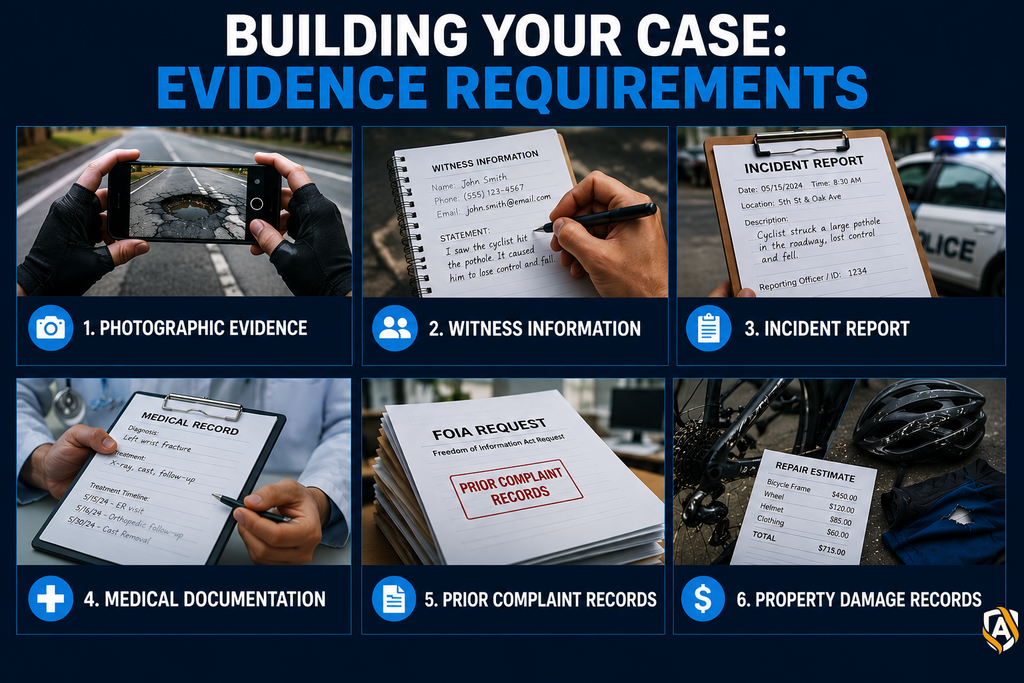
Immediate documentation preserves claim viability. High-quality photographs showing pothole size, depth, and position relative to identifiable landmarks are essential. Take images immediately after the incident before conditions change or repairs occur.
Gather witness contact information and statements documenting accident circumstances. File an incident report with the city or police detailing accident specifics and exact location. Obtain medical documentation linking your injuries to the incident with a clear treatment timeline.
Request prior complaint records through Freedom of Information Act requests to prove the city had previous notice about the same pothole location. Document all property damage to your bicycle, helmet, clothing, and personal items with repair estimates.
Recent Court Rulings: Diverging Legal Landscape
State courts are taking dramatically different approaches to cyclist protection. The Illinois Supreme Court's 2023 decision in Alave v. City of Chicago ruled that cities carry no liability for bicycle accidents caused by potholes on roads without designated bike lanes or signage. The court distinguished between "permitted" and "intended" road users, determining cyclists are only intended users on designated bike infrastructure.
California takes the opposite approach. In Williams v. County of Sonoma, the court held that counties owe a duty to maintain safe roads for all foreseeable uses, including recreational cycling. The $1.3 million jury verdict demonstrated California's expansive protection approach.
The California Supreme Court reinforced this standard in May 2025, ruling Oakland could be held liable despite a cyclist's signed waiver during an organized ride. An "affirmative act exception" also applies when city employees create dangerous conditions through negligent road work, establishing liability even without prior notice.
Compensation Realities: What to Expect
National bicycle accident settlements average $233,028, though the median settlement is significantly lower at $45,000. Pothole-specific settlements typically range from $7,000 to $30,000 depending on injury severity and jurisdiction.
Compensable damages include medical costs (past and future), lost wages and income, pain and suffering, and property damage to your bicycle and gear. State damage caps significantly reduce recovery potential-Massachusetts roadway defect claims are capped at just $5,000 despite potentially catastrophic injuries.
Settlement amounts reflect injury severity, permanent disability, jurisdiction, and municipal liability limits. Non-economic damages caps in eleven states further limit pain and suffering recovery, making cost-benefit analysis essential before pursuing claims.
Decision Framework: Evaluating Your Claim Viability
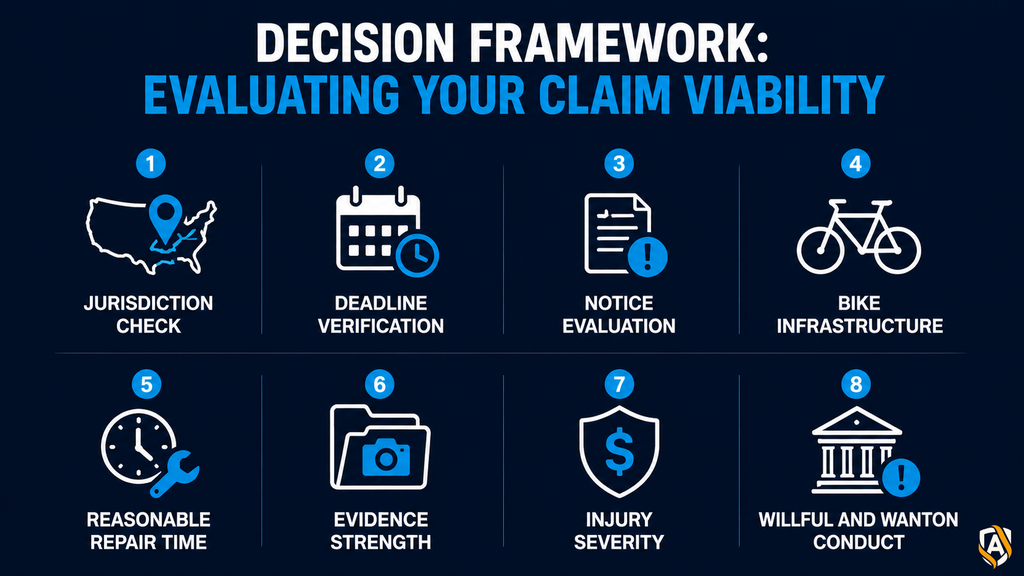
Jurisdiction Check: Identify your state and city's applicable Tort Claims Act. Verify whether damage caps make your claim economically unviable given injury severity and medical costs.
Deadline Verification: Calculate days since your accident. Determine if your notice deadline has passed or is imminent-deadlines as short as 30 days can permanently bar otherwise valid claims.
Notice Evaluation: Can you prove actual notice through prior complaints or city records? For constructive notice, assess pothole size, duration, and obviousness based on your jurisdiction's standards.
Bike Infrastructure: In Illinois and similar jurisdictions, did your accident occur on a designated bike lane or route, or on an ordinary road without bicycle signage?
Reasonable Repair Time: If the city had notice, did sufficient time pass for reasonable repair based on your jurisdiction's standards (72 hours to 30+ days)?
Evidence Strength: Do you have photographs, witness statements, medical documentation, and property damage records? Can you obtain prior complaint records through FOIA requests?
Injury Severity: Are your medical costs and damages substantial enough to exceed likely settlement costs and attorney fees (typically 33-40% contingency)?
Willful and Wanton Conduct: Did the city know about the hazard and deliberately ignore repeated complaints, showing reckless disregard for public safety?
Conclusion
Municipal pothole liability exists but faces substantial immunity barriers and strict procedural requirements. Success requires proving prior notice, demonstrating failure to repair within reasonable time, and meeting filing deadlines that can be as short as 30 days in some jurisdictions.
State-by-state variations in notice requirements, damage caps, and cyclist protection levels critically impact claim viability. Immediate documentation-including photographs, witness information, medical records, and FOIA requests-is essential to preserve evidence before conditions change.
Use the decision framework checklist to assess claim strength. If a viable claim exists, consult an attorney immediately given short filing windows. Even strong claims may face damage caps limiting recovery to amounts below actual injury costs, making realistic expectations essential.
Frequently Asked Questions
How long do I have to file a pothole injury claim against a city?
Filing deadlines vary by state from 30 days to six months for notice of claim submission. New Jersey requires 90 days, California allows six months, and New York mandates 90 days for notice followed by one year and 90 days for the lawsuit. Deadlines begin from the accident date, not injury discovery. Missing these deadlines permanently bars your claim regardless of merit.
Can I sue if I was riding on a road without a bike lane?
Depends on your state's laws and recent court rulings. Illinois's Alave v. City of Chicago (2023) ruled cities aren't liable for potholes on roads without designated bike lanes or signage, distinguishing between "permitted" and "intended" users. California's Williams v. County of Sonoma (2020) held counties owe a duty to all foreseeable road users including cyclists. Most states follow California's approach recognizing cyclists as legitimate road users.
What if the city didn't know about the pothole?
The constructive notice doctrine allows recovery if the pothole was obvious and existed long enough the city should have discovered it during regular inspections. Most courts consider six to eight weeks sufficient time for discovery. You must prove the defect was discoverable with reasonable care based on size, location, and obviousness. New York City's prior written notice statute eliminates constructive notice, requiring actual written complaints.
What damages can I recover in a pothole bicycle accident claim?
Compensable damages typically include medical costs (past and future), lost wages and income, pain and suffering, and property damage to your bicycle, helmet, and personal items. However, state damage caps significantly limit recovery-Massachusetts restricts roadway defect claims at the municipal level to $5,000, while Texas caps city liability at $250,000 per person. Some states like Minnesota exclude lost wages, mental anguish, and punitive damages from governmental claims.
How do I prove the city had notice of the pothole?
Actual notice requires evidence the city was directly informed through complaints, work orders, or employee observations. Submit Freedom of Information Act requests to obtain prior complaint records about the same location. For constructive notice, document pothole size, depth, and obvious danger with photographs showing it existed long enough (typically six to eight weeks) for discovery during regular maintenance. Evidence of surrounding deterioration or previous repairs nearby strengthens constructive notice arguments.
About the Author

Aaron B Mickens
For over 25 years, Aaron has fought for justice on behalf of Austin's injured. He is committed to standing up to insurance companies and winning for clients across Central Texas.
View all articles by AaronNeed Legal Help?
Contact our experienced Austin personal injury attorneys for a free consultation.