%20Violations.png)
Proving Truck Driver Hours of Service (HOS) Violations
The truck fatigue crisis claims thousands of lives annually, with 4,490 fatal large truck accidents occurring in 2024 alone. The Large Truck Crash Causation Study reveals that 13% of commercial motor vehicle drivers were fatigued at the time of serious crashes. Alarmingly, 82.4% of truck crash fatalities are innocent victims-not the truck driver or passengers.
Hours of Service violations represent both preventable regulatory failures and powerful litigation leverage. Federal law treats HOS violations as negligence per se, meaning the violation itself establishes breach of duty. The Electronic Logging Device mandate implemented in 2020 creates a tamper-proof digital evidence trail that prosecutors and plaintiff attorneys can leverage. Recent FMCSA audit data shows that 94% of 2024 investigations found violations, resulting in over $27 million in fines. However, time is critical-ELD devices store data for only 8 days before auto-deletion.
Understanding Federal HOS Regulations
The Federal Motor Carrier Safety Administration regulates hours of service under 49 CFR Part 395. These rules establish clear violation thresholds attorneys can quickly identify in crash investigations.
Property-carrying vehicle drivers face an 11-hour driving limit after 10 consecutive hours off duty. The 14-hour on-duty window restricts all work activities and cannot be extended with breaks-only 11 hours of actual driving are permitted within this window. Drivers must take a 30-minute break after 8 hours of driving, though short-haul exception drivers are exempt.
Weekly limits include 60 hours on-duty in 7 consecutive days or 70 hours in 8 consecutive days for carriers operating daily. A continuous 34-hour restart resets this weekly clock to zero. The short-haul exception has been extended to 150 air-miles (approximately 175 statute miles) with a maximum 14-hour duty period.
Adverse driving conditions allow 2-hour extensions of both the 11-hour and 14-hour limits, but drivers must document the date, time, and specific circumstances. Sleeper berth provisions permit split rest periods with minimum 8 consecutive hours in the sleeper berth plus a separate 2-hour period.
How ELD Technology Proves Violations
The Electronic Logging Device mandate revolutionized HOS enforcement and truck accident litigation. ELDs automatically record driving time, ignition cycles, vehicle movement, and rest periods-creating evidence far more reliable than easily-falsified paper logs.
All carriers must use FMCSA-certified and registered ELD devices, except for short-haul operations and vehicles manufactured before model year 2000. Canada and Mexico-domiciled drivers operating in the United States also fall under this requirement. The mandate applies to commercial drivers required to maintain Records of Duty Status per 49 CFR 395.8(a).
Federal law requires carriers to retain ELD data for 6 months, but the critical vulnerability is device storage-most ELD systems store data for only 8 days before overwriting. This creates an urgent preservation window for truck accident attorneys.
ELD technology proves violations through cross-referencing. Investigators compare ELD data against GPS records, fuel receipts, and toll records to expose discrepancies. Any mismatch between logbooks and these supporting documents signals falsified entries, strengthening both regulatory enforcement and civil litigation claims.
Common HOS Violations & Crash Impact
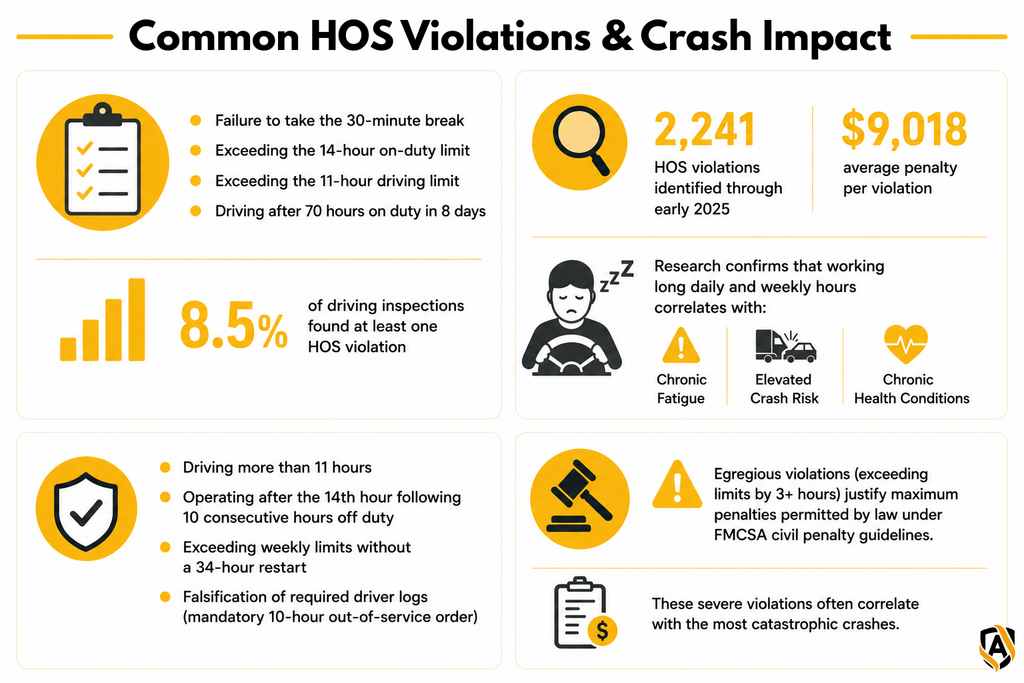
Post-2020 inspection data reveals that 8.5% of driving inspections uncovered at least one HOS violation. The most frequently cited violations include failure to take the 30-minute break, exceeding the 14-hour on-duty limit, exceeding the 11-hour driving limit, and driving after 70 hours on duty in 8 days.
Through early 2025, FMCSA investigations identified 2,241 HOS violations with an average penalty of $9,018 per violation. Research confirms that working long daily and weekly hours correlates with chronic fatigue, elevated crash risk, and chronic health conditions.
The Commercial Vehicle Safety Alliance Out-of-Service Criteria identifies critical violations requiring immediate action. Drivers are placed out-of-service for driving more than 11 hours, operating after the 14th hour following 10 consecutive hours off duty, or exceeding weekly limits without a 34-hour restart. Falsification of required driver logs triggers a mandatory 10-hour out-of-service order.
Egregious violations-defined as exceeding limits by 3 or more hours-justify maximum penalties permitted by law under current FMCSA civil penalty guidelines. These severe violations often correlate with the most catastrophic crashes.
Evidence Collection & Preservation Strategy
Send a spoliation letter within 24-48 hours of the crash. While federal regulations require 6-month ELD retention, the 8-day device storage limitation necessitates immediate action. Once your spoliation letter is received, the carrier assumes a legal duty to preserve all evidence regardless of standard retention schedules.
Critical evidence includes ELD records, GPS tracking data, Engine Control Module downloads, fuel and toll receipts, dispatch communications, phone activity records, and dashcam footage. Many commercial vehicles have dashcam systems that auto-delete footage within days, making early preservation essential.
Build a cross-referenced timeline comparing ELD logs against GPS coordinates, fuel purchase timestamps, toll records, and bills of lading. Discrepancies between these sources expose falsification and strengthen negligence claims. Subpoena third parties including maintenance shops, cargo loading facilities, and ELD technology vendors to obtain independent verification.
Driver Qualification Files maintained under 49 CFR Part 391 reveal hiring negligence patterns. These files must contain the driver's employment application, Motor Vehicle Records for the preceding 3 years, Medical Examiner's Certificates, CDL copies with endorsements, Drug & Alcohol Clearinghouse queries, and Safety Performance History investigations. Missing or incomplete DQF elements support employer liability claims, as FMCSA data shows 62,000+ driver file violations in recent years-nearly 17% of all violations recorded.
Motor Carrier Liability & Legal Standards
Federal regulations impose strict liability on motor carriers for HOS violations. Under FMCSA guidelines, carriers are liable if they "had or should have had the means to detect violations"-intent or actual knowledge is not required. Carriers "permit" violations when they fail to implement effective management systems that prevent such conduct.
HOS violations trigger the negligence per se doctrine, treating regulatory violations as negligence as a matter of law. This legal principle simplifies the plaintiff's burden significantly-you need only prove the violation occurred and that it directly contributed to the accident. The defendant must explain their regulatory non-compliance rather than forcing plaintiffs to establish each traditional negligence element.
Carriers remain liable for employee actions under respondeat superior principles. The CSA Safety Measurement System tracks HOS violations in the HOS Compliance BASIC (Behavior Analysis and Safety Improvement Category) for 24 months, affecting carrier safety ratings and providing litigation discovery regarding systemic violations.
Punitive Damages & Case Valuation
Punitive damages require clear and convincing proof of egregious conduct-malicious behavior or despicable conduct with willful and conscious disregard of rights and safety. HOS violation cases frequently meet this threshold.
In Torres, a driver's failure to log time combined with employer knowledge and disregard supported punitive damages awards. Bridges v. Enterprise Products demonstrates how HOS violations combined with falsified driver logs defeated summary judgment motions on punitive claims. Courts consistently hold that knowingly sending an exhausted driver onto the road in violation of FMCSA regulations constitutes the willful misconduct that punitive damages address.
Spoliation of evidence significantly increases case value. When carriers destroy ELD data, GPS records, or other critical evidence after receiving notice of litigation, courts may impose sanctions including jury instructions to assume destroyed evidence was unfavorable to the defendant. These adverse inference instructions dramatically shift jury perception.
HOS violation cases with strong evidence support recovery of economic damages (medical expenses, lost wages), non-economic damages (pain and suffering), and punitive damages where violations were willful. Recent notable awards include a $70.5 million "nuclear verdict" and a $27 million settlement in cases where HOS violations played central roles.
Decision Framework: Evidence Strength Assessment
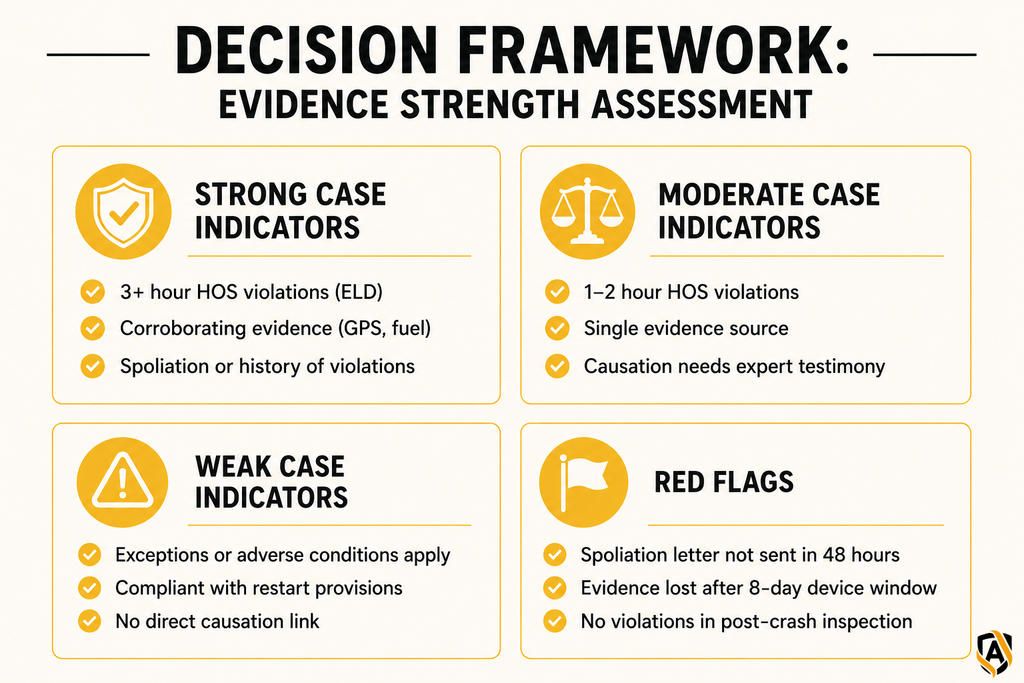
Strong Case Indicators: ELD data showing 3+ hour violations, GPS and fuel receipts corroborating the violation, spoliation of evidence occurred, carrier history of repeated violations, driver documented as fatigued in police crash reports.
Moderate Case Indicators: 1-2 hour violations, single evidence source without corroboration, no prior carrier violation history, no spoliation occurred, causation link requires expert testimony.
Weak Case Indicators: Short-haul exception applies, adverse driving conditions properly documented, driver complied with restart provisions, no direct causation link between violation and crash mechanics.
Red Flags: Spoliation letter not sent within 48 hours, evidence sought after 8-day device storage window expired, case relies solely on paper logs from pre-2020 period, no regulatory violations cited in post-crash inspection.
Conclusion
Time is your most critical resource in HOS violation cases. The 8-day ELD device storage window, dashcam auto-deletion schedules, and carrier spoliation risks demand immediate action. Send your spoliation letter within 24-48 hours to create an affirmative legal duty to preserve evidence.
HOS violations provide a negligence per se foundation-the regulatory breach establishes presumptive fault, shifting the burden to defendants to justify non-compliance. Multi-source evidence corroboration using ELD data, GPS tracking, fuel receipts, and toll records defeats alternative causation theories and exposes falsification patterns.
Remember that strict liability attaches regardless of carrier intent under federal standards. Punitive damages become accessible where violations were willful or employer knowledge is demonstrated through internal communications or systemic patterns. With 94% of carriers exhibiting violations in recent audits, your role is proving causation and quantifying damages.
Build your timeline immediately, subpoena third-party records, and leverage the powerful evidentiary advantages that modern ELD technology provides. The regulatory framework supports plaintiffs-use it strategically.
Frequently Asked Questions
How quickly must I preserve ELD evidence after a truck accident?
Send a spoliation letter within 24-48 hours of the crash. While federal law requires carriers to retain ELD records for 6 months, the device itself may only store data for 8 days before auto-deletion. Once your spoliation letter is received, the carrier has a legal duty to preserve all evidence regardless of standard retention periods. Failure to preserve can result in spoliation sanctions, including jury instructions to assume destroyed evidence was unfavorable to the defendant.
What is negligence per se and how does it help my truck accident case?
Negligence per se means the defendant's violation of a safety statute designed to protect the public constitutes negligence as a matter of law. In HOS cases, if ELD data shows the driver violated 49 CFR Part 395 limits (11-hour, 14-hour, etc.), that violation alone establishes the "breach of duty" element. You only need to prove causation and damages, significantly simplifying your burden compared to traditional negligence claims.
Can I recover punitive damages for HOS violations?
Yes, if you prove by clear and convincing evidence that the violation was willful or the employer knowingly sent an exhausted driver onto the road. Cases like Torres (driver failed to log time, employer knew) and Bridges v. Enterprise Products (HOS violations plus falsified logs) resulted in punitive damages awards or survived summary judgment on punitive claims. Spoliation of evidence also strengthens punitive claims, with notable verdicts including $70.5 million and $27 million settlements where HOS violations played central roles.
What evidence besides ELD logs can prove HOS violations?
Build a multi-source timeline using GPS data showing location and movement patterns, fuel and toll receipts with timestamps, Engine Control Module downloads capturing ignition cycles, phone activity records corroborating driving periods, dispatch communications showing pressure to violate rules, bills of lading and delivery records for cross-checking timing, and dashcam footage. FMCSA investigators compare these sources with ELD data to uncover discrepancies. Additionally, Driver Qualification Files reveal hiring negligence through incomplete Motor Vehicle Records, expired medical certificates, or missing Safety Performance History checks.
What are the federal penalties for HOS violations in 2025?
As of December 2024, maximum civil penalties are up to $19,246 per violation against carriers for most HOS violations, $4,812 per violation against drivers, and $15,846 for knowing falsification of records. "Egregious" violations-exceeding 11-hour or 10-hour limits by 3 or more hours-justify maximum penalties. Recordkeeping violations can reach $1,584 per day up to $15,846 total. In 2025, FMCSA investigations found 2,241 HOS violations with an average penalty of $9,018 per violation.
About the Author

Aaron B Mickens
For over 25 years, Aaron has fought for justice on behalf of Austin's injured. He is committed to standing up to insurance companies and winning for clients across Central Texas.
View all articles by AaronNeed Legal Help?
Contact our experienced Austin personal injury attorneys for a free consultation.