Uber Driver Caused Crash? Passenger Rights & Injury Claims
Every day, millions of passengers trust rideshare drivers to get them safely to their destination. But what happens when that trust is shattered by a collision? In 2018 alone, Uber drivers and passengers were involved in 4,853 reported crashes across the United States, with 3,638 resulting in serious injuries. Even more sobering: passengers comprised 21% of all rideshare fatalities.
Unlike drivers who have some control over their safety, passengers are completely vulnerable in the back seat. And if you think Uber's insurance will fully protect you, think again. California's 2026 insurance changes reduced coverage by a staggering 94% in certain scenarios. This guide reveals what every rideshare passenger must know to protect themselves when their driver causes an accident.
Understanding Your Coverage: The Three Insurance Periods
Rideshare insurance operates on a complex three-period framework that determines what coverage applies when. Understanding these periods is crucial because your protection varies dramatically depending on when the accident occurs.
Period 1 (driver logged in, waiting for requests) provides minimal coverage: Texas requires just $50,000 per person for bodily injury, $100,000 per incident, and $25,000 for property damage. California mandates excess coverage of at least $200,000 per occurrence during this period.
Period 2 (ride accepted, en route to pickup) offers better protection. Federal guidelines require mandatory $1 million primary liability coverage from the moment a driver accepts your ride until you enter the vehicle.
Period 3 (passenger in vehicle) maintains the $1 million third-party liability coverage when the Uber driver is at fault. However, here's the critical gap: when a third-party driver causes the accident and lacks insurance, California now provides only $60,000 per person-down from $1 million before January 2026.
Uber and Lyft aren't required to maintain medical payments, comprehensive, or collision coverage beyond these specified minimums, leaving potential gaps in your protection.
What to Do Immediately After an Uber Accident
The actions you take in the first minutes after a rideshare accident can make or break your injury claim. Follow this critical checklist:
First, check for injuries and call 911. Seek medical attention even if you feel fine-adrenaline often masks pain and injury symptoms for hours or even days. Request a police report and obtain the report number before leaving the scene.
Document everything immediately. Take photos of the accident scene, all vehicles involved, visible damages, and any injuries. Save your Uber trip receipt from the app-this proves your involvement in the ride at the specific time, date, and location. Collect witness statements and contact information.
Report strategically. Notify the police, the rideshare company, and your own insurance carrier. However, avoid giving recorded statements to insurance companies without consulting an attorney first. Both Uber and Lyft record every word on these calls and will use your statements to minimize your claim.
Police reports provide an unbiased official account that becomes pivotal when disputes arise about fault or liability. Medical records document the extent of your injuries and support your compensation claim.
Who Pays When You're Injured: Liability Scenarios
Understanding which insurance pays depends entirely on who caused the accident-and this question gets complicated fast.
When your Uber driver is at fault, the company's $1 million third-party liability policy covers your injuries, including medical expenses, lost wages, pain and suffering, and future treatment costs. This coverage remains intact across all states.
When another driver causes the accident, their insurance pays first, with Uber's commercial policy serving as backup. If that third-party driver has insurance, you're generally well-protected through multiple coverage layers.
When the at-fault driver is uninsured or underinsured, you rely on Uber's uninsured/underinsured motorist (UM/UIM) coverage, which varies dramatically by state. California's reduction to just $60,000 per person leaves passengers dangerously exposed. In hit-and-run scenarios where the at-fault driver flees, Uber's UM coverage must step in.
The complexity multiplies quickly: 47% of rideshare accident claims involve three or more defendants, and studies show 60% of rideshare accidents involve multiple parties sharing some degree of fault. Your personal auto insurance's UM/UIM coverage may provide additional protection even when you're a passenger in another vehicle-making it critical to carry personal limits of $100,000/$300,000 or higher.
Common Injuries and Settlement Ranges
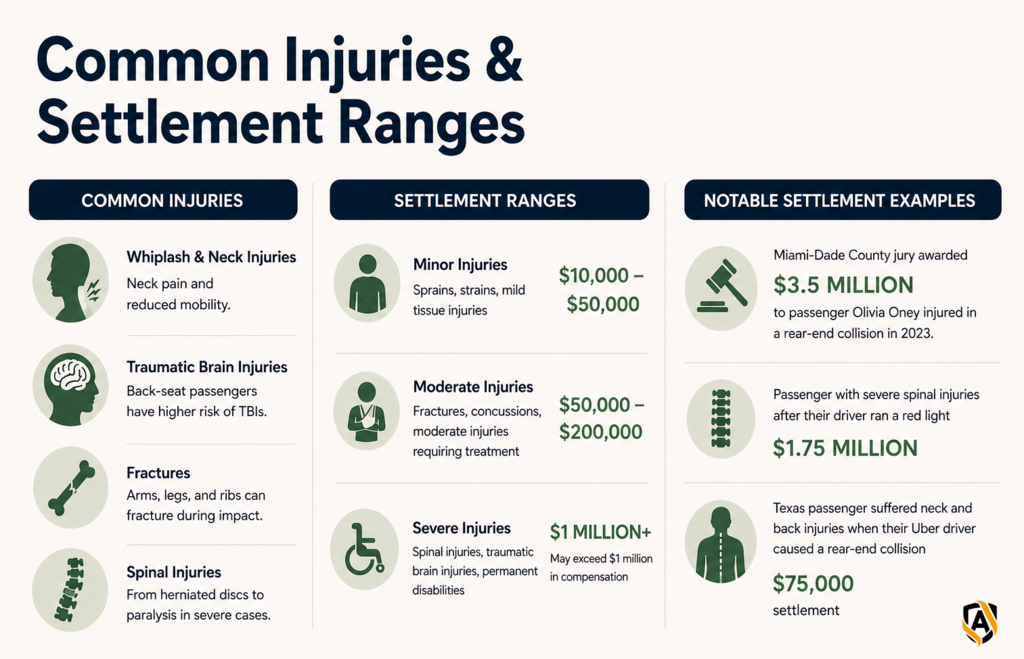
Rideshare passenger injuries span from minor to catastrophic, with settlement amounts reflecting the severity and long-term impact.
The most common injuries include whiplash from rear-end collisions, causing neck pain and reduced mobility. Recent studies show back-seat passengers experience higher rates of traumatic brain injuries than front-seat occupants. Fractures to arms, legs, and ribs frequently occur when passengers brace during impact, while spinal injuries can range from herniated discs to paralysis in severe high-impact collisions.
Settlement ranges vary widely by injury severity. Minor injuries typically result in $10,000 to $50,000 settlements. Moderate injuries-including fractures, concussions, and extended treatment-commonly yield $50,000 to $200,000. Severe injuries may exceed $1 million in compensation.
Notable examples demonstrate the potential value of serious claims. A Miami-Dade County jury awarded $3.5 million to passenger Olivia Oney injured in a rear-end collision in 2023. A passenger with severe spinal injuries after their driver ran a red light received $1.75 million. A Texas passenger suffered neck and back injuries when their Uber driver caused a rear-end collision and settled for $75,000.
Compensation covers past and future medical expenses, lost wages from inability to work, pain and suffering, emotional distress, and anticipated ongoing medical care costs.
State-Specific Considerations: Time Limits and Fault Rules
Your state of residence dramatically impacts your legal rights and recovery potential through two critical factors: statute of limitations and comparative negligence rules.
Time limits to file claims vary from one to four years depending on your state. California and Texas both allow two years from the accident date to file a personal injury lawsuit. Florida and Nevada also impose two-year deadlines, while Colorado extends this to three years. These deadlines are absolute-missing them permanently bars your right to recover compensation. Claims involving government entities may have even shorter timeframes.
Fault determination systems affect how much you can recover. California and Washington follow "pure comparative negligence," allowing recovery regardless of your percentage of fault. New Jersey, Colorado, and Georgia use "modified comparative negligence" with a 51% rule-you can only recover damages if you're 50% or less at fault.
Personal Injury Protection (PIP) requirements add another layer. Sixteen states mandate PIP coverage, while Illinois uniquely requires it specifically for ridesharing companies. Michigan demands the highest PIP coverage at $250,000-five times higher than the next-highest state. In PIP states, this coverage may help pay immediate medical bills regardless of fault.
California's 2026 insurance changes only apply within California, but they signal a troubling trend that other states may follow.
Decision Framework: When to Hire a Lawyer
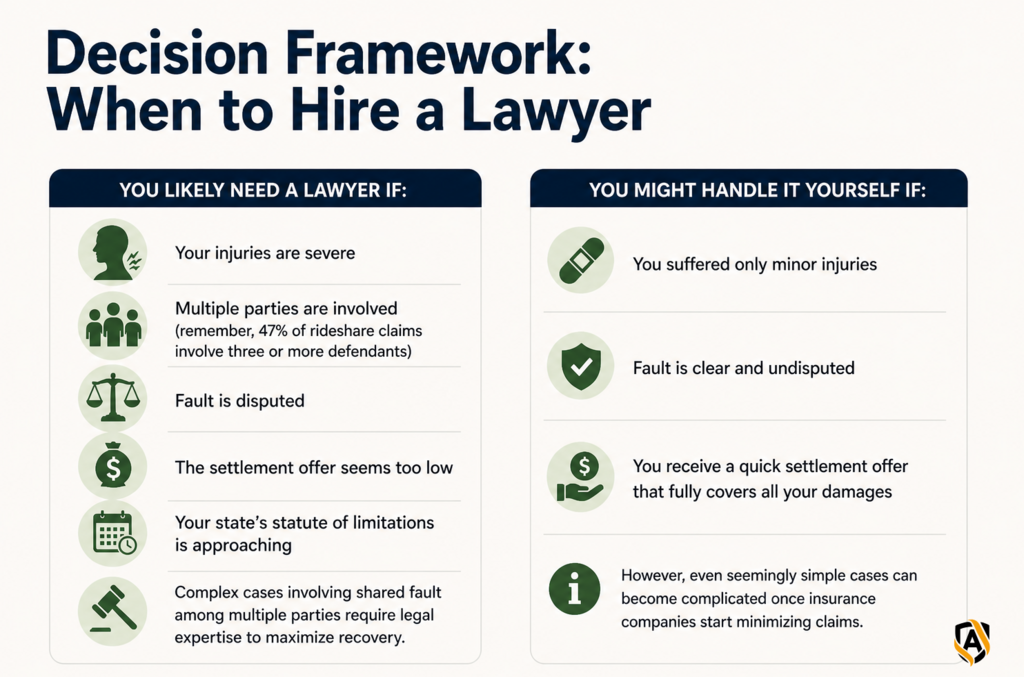
Not every rideshare accident requires an attorney, but many situations demand professional legal representation.
You likely need a lawyer if: your injuries are severe, multiple parties are involved (remember, 47% of rideshare claims involve three or more defendants), fault is disputed, the settlement offer seems too low, or your state's statute of limitations is approaching. Complex cases involving shared fault among multiple parties require legal expertise to maximize recovery.
You might handle it yourself if: you suffered only minor injuries, fault is clear and undisputed, and you receive a quick settlement offer that fully covers all your damages. However, even seemingly simple cases can become complicated once insurance companies start minimizing claims.
Rideshare accident attorneys work on contingency fees-meaning no upfront costs to you. They're paid only if you win your case. Given that insurance companies record all phone conversations and employ teams of adjusters trained to minimize payouts, having experienced representation levels the playing field.
Protect Yourself Beyond the Ride
Rideshare passengers enjoy strong legal protections-companies and drivers owe you a high duty of care during your ride-but you must know how to exercise these rights effectively.
The 2026 California coverage reduction from $1 million to $60,000 demonstrates that passengers can no longer rely solely on rideshare company insurance. Document everything immediately after any accident: photos, police reports, medical records, and trip receipts form the foundation of your claim.
Take proactive steps now. Check your personal auto insurance policy for UM/UIM coverage. Industry experts strongly recommend maintaining personal limits of at least $100,000/$300,000 or higher that apply even when you're a passenger in another vehicle. This supplemental protection fills critical gaps in rideshare coverage.
Know your state's statute of limitations and comparative negligence rules. Understand the three insurance periods and what coverage applies during each. For serious injuries or cases involving multiple parties and disputed fault, seek legal representation early to preserve your rights and maximize your recovery.
Frequently Asked Questions
Am I covered if the Uber driver is at fault?
Yes, absolutely. When your Uber driver causes the accident and you're a passenger in the vehicle (Period 3), Uber's $1 million third-party liability policy covers your injuries. This coverage applies in all U.S. states and includes medical expenses, lost wages, pain and suffering, and future treatment costs. Passengers typically have no contributory negligence-meaning rideshare companies and drivers owe you a high duty of care. You can recover full damages for injuries sustained during your ride when the driver is at fault.
What if another driver hit our Uber and they don't have insurance?
This scenario exposes a major coverage gap that varies significantly by state. If an uninsured or underinsured third-party driver causes your accident, you rely on Uber's uninsured/underinsured motorist (UM/UIM) coverage. California drastically reduced this protection from $1 million to just $60,000 per person effective January 1, 2026-a shocking 94% decrease. Your personal auto insurance's UM/UIM coverage may apply even when you're a passenger in another vehicle. Insurance experts strongly recommend carrying personal UM/UIM limits of $100,000/$300,000 or higher to protect yourself against this dangerous coverage gap.
How long do I have to file a claim after an Uber accident?
The statute of limitations varies by state, typically ranging from one to four years from the accident date. Most states allow two years: California, Texas, Florida, and Nevada all impose two-year deadlines for personal injury claims. Colorado extends this to three years. These deadlines are strictly enforced-missing them means permanently losing your right to recover any compensation. Claims against government entities may have even shorter timeframes with special notice requirements. Document your accident immediately and consult with an attorney to ensure you meet all applicable deadlines in your state.
Will my own car insurance cover me as an Uber passenger?
It depends on your specific policy coverage. If you carry uninsured/underinsured motorist (UM/UIM) coverage, it typically applies even when you're a passenger in another vehicle, including rideshares. This supplemental protection becomes especially critical in California after the 2026 coverage reduction. Personal Injury Protection (PIP) coverage may also apply if you reside in one of the 16 states requiring PIP insurance. However, your liability coverage won't apply since you weren't driving. Review your policy declarations page or contact your insurance carrier to confirm what passenger coverage you have-and consider increasing your UM/UIM limits to $100,000/$300,000 or higher.
Do I need a lawyer for an Uber accident injury claim?
Not always, but often yes. You likely need an attorney if you suffered serious or permanent injuries, multiple parties are involved (47% of rideshare claims involve three or more defendants), fault is disputed between drivers, or the insurance company's settlement offer seems inadequate. Studies show 60% of rideshare accidents involve multiple parties sharing fault-these cases require legal expertise to navigate successfully. For minor injuries with clear liability and a fair settlement offer, you might handle the claim yourself. Rideshare accident attorneys work on contingency fees with no upfront costs. Never provide recorded statements to insurance companies without consulting an attorney first-insurers record every word and use your statements to minimize payouts.
About the Author

Aaron B Mickens
For over 25 years, Aaron has fought for justice on behalf of Austin's injured. He is committed to standing up to insurance companies and winning for clients across Central Texas.
View all articles by AaronNeed Legal Help?
Contact our experienced Austin personal injury attorneys for a free consultation.