UT Austin Student Injuries after Car and Pedestrian Accidents in West Campus
If you or your student goes to UT Austin and spends time on campus or in West Campus, you already know how busy the streets can get. This guide explains what usually happens after a UT Austin student car accident or West Campus pedestrian accident, how insurance often works for students, and when it makes sense to talk with a lawyer.
Why UT Austin and West Campus see so many crashes
The area around UT Austin has heavy traffic, lots of students on foot, and a mix of cars, scooters, bikes, and buses all using the same space. Studies that looked at crashes within about a half mile of campus found more than two thousand reported crashes between 2017 and 2020, and at least 179 of those involved a pedestrian or bicyclist.
Guadalupe Street and the West Campus neighborhood carry much of the vehicle and foot traffic for the university, with dense student housing on the west side of Guadalupe and campus on the east side.
Focus groups with people who walk and bike around campus report daily safety concerns and many near misses.
The City of Austin also tracks serious traffic injuries and deaths through its Vision Zero program and uses that data to target safety projects across the city, including central Austin.
For parents, this means your student is walking, biking, or riding in cars in an area that is beautiful and lively, but also genuinely high risk for traffic crashes.
Common ways UT students get hurt near campus
Here are some of the most common patterns around campus and in West Campus:
A student in a crosswalk on Guadalupe or a side street is hit by a turning driver who is looking for a gap in traffic but not for pedestrians.
A West Campus pedestrian accident happens at night when a student crosses midblock between apartments and the driver does not see them in time.
A student on an e scooter or bike is struck at an intersection, or wipes out because of road conditions and then gets hit by a passing car. Recent news has covered a fatal scooter crash near campus and other serious incidents.
A rideshare or food delivery driver pulls into or out of a driveway, alley, or parking garage and hits a pedestrian or another car.
A crash happens in a drive through near campus, such as the widely reported pickup crash at a Raising Canes where several pedestrians were injured and one driver was accused of intoxication assault.
In any of these situations, the same basic Texas personal injury rules usually apply, but the mix of student insurance, parent insurance, and campus systems can make the process feel more complicated.
Texas traffic law basics for campus and West Campus
Drivers must yield to pedestrians in many crosswalks
Under Texas law, drivers generally must stop and yield to a pedestrian who is in a crosswalk when there is no working traffic signal and the person is on the drivers half of the road or close enough to be in danger.
If a pedestrian crosses the road somewhere that is not a crosswalk, Texas law usually requires the pedestrian to yield to vehicles.
In simple terms:
In a proper crosswalk, the driver often has the main duty to watch and stop.
Outside a crosswalk, the pedestrian often has the main duty to wait for a safe gap.
Texas uses a shared fault system
Texas follows a rule called proportionate responsibility. In plain English, this means fault can be shared between the driver, the pedestrian, and sometimes others. If an injured person is more than 50 percent at fault, they usually cannot recover money in a lawsuit.
Example:
A driver is speeding on the Drag.
A student suddenly runs out midblock between cars while looking at a phone.
A jury might decide both share blame. If they think the student is 40 percent at fault and the driver is 60 percent at fault, the student could still recover, but the award would be cut by 40 percent. If they thought the student was 60 percent at fault, the student would recover nothing.
Step by step, what to do after an accident on or near campus
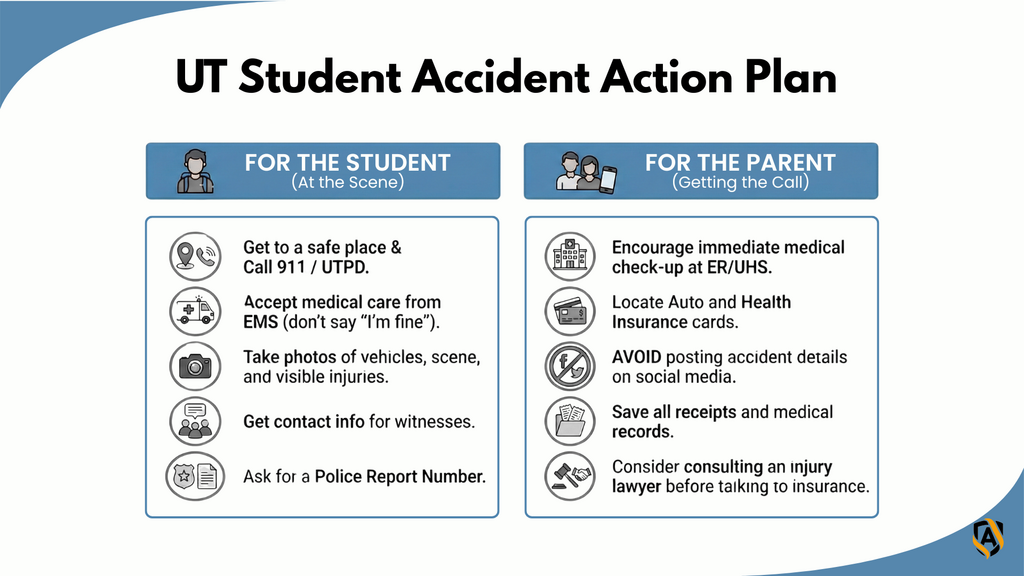
For the student at the scene
Get to a safe place and call for help. Call 911 for serious injuries. On campus, you can also contact UTPD. In West Campus, Austin Police may respond, sometimes along with UTPD.
Accept medical care. Many students worry about cost and say they are fine. It is usually better to let EMS check you out and to go to the ER or urgent care if they suggest it. Some serious injuries, including concussions and internal injuries, do not show up right away.
Document the scene if you can.
Take photos of the vehicles, the street, any crosswalk markings, and your visible injuries.
Get names and contact information for witnesses and other students who saw what happened.
Make note of cameras nearby, such as apartment buildings, restaurants, or street cameras.
Ask for a police report number. A written crash report is very important for insurance later.
Save everything. Keep medical records, discharge instructions, receipts, and screenshots of any messages with the driver or witnesses.
For parents who get the call
If you are a parent getting a late night call from Austin, a few steps can help:
Encourage your student to get medical care right away and to follow up at University Health Services or their regular doctor.
Help them locate their auto and health insurance cards, including any family plans.
Try to avoid posting details about the crash on social media until you know more and have spoken with a lawyer if needed.
If injuries are significant or there are questions about fault, consider speaking with a UT Austin student car accident lawyer who is familiar with West Campus collisions.
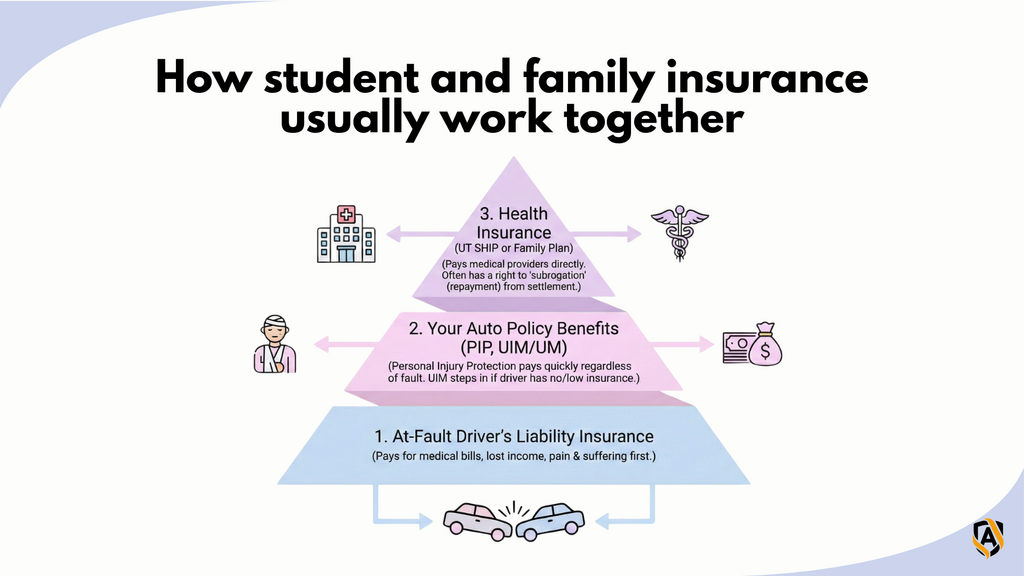
How student and family insurance usually work together
Every case is different, but here is how the main pieces often fit together after a UT Austin student car accident or West Campus pedestrian accident.
Auto insurance
Texas is an at fault state, so the starting point is usually the liability insurance for the driver who caused the crash. That policy may pay for:
Medical bills
Lost income
Pain and suffering
Property damage, such as a "totaled car" or destroyed laptop
Many students are covered by more than one auto policy:
Their own Texas policy on a vehicle they keep in Austin
A parent policy back home if they are listed as a driver or qualify as a household family member
A rideshare or delivery company policy if they were a passenger or the driver who was working at the time
Personal Injury Protection and similar benefits
Texas requires auto insurers to offer Personal Injury Protection, often called PIP. Drivers can reject it in writing, but if they do not, it is usually part of the policy. PIP pays for medical costs and some lost wages for the policyholder and some family members, regardless of who was at fault.
Important points for students and parents:
PIP money can arrive faster than a settlement with the at fault drivers insurer.
It may cover things like copays, deductibles, and some lost income from part time jobs.
PIP can exist on both a student policy and a parent policy, depending on how the policies are written.
Many Texas policies also include uninsured and underinsured motorist coverage, which can help if the at fault driver has no insurance or not enough insurance.
Student health insurance and family health insurance
UT Austin offers a Student Health Insurance Plan, currently through Blue Cross Blue Shield, that pays one hundred percent for covered services at University Health Services and also has in network and out of network benefits off campus, including nationwide coverage.
In addition, many students are still covered on a parent employer plan or another private health plan. Health insurance usually:
Pays medical bills according to the plan rules, no matter who was at fault
May require copays, deductibles, and out of pocket maximums
Often has a right to be repaid from any injury settlement, called subrogation
In plain language, health insurance helps keep treatment available while the injury claim is pending. Later, if there is a settlement, part of that money may have to go back to the health insurer.
When UT or another government entity is involved
Sometimes the crash involves a UT shuttle, a UT vehicle, or a city bus, or it relates to a street or sidewalk condition. In those situations, special rules may apply because UT Austin and the City of Austin are government units.
Texas has a law called the Texas Tort Claims Act. It allows people to make certain injury claims against government units, including the University of Texas System, when a government employee negligently uses a motor vehicle or when certain conditions on property cause harm.
This law also:
Caps how much money can be recovered from a state government unit, such as UT, at two hundred fifty thousand dollars per person and five hundred thousand dollars per event for injury or death.
Requires notice within a short time, often within six months of the incident, unless the government already has actual notice of the injury.
Because these rules are strict, students and parents should treat crashes involving UT vehicles, city buses, or dangerous conditions on public property as urgent and speak with a lawyer familiar with Texas Tort Claims Act cases.
Time limits for UT Austin student injury claims
For most Texas personal injury cases, including many car and pedestrian accidents, the general deadline to file a lawsuit is two years from the date of the injury. That rule comes from Texas Civil Practice and Remedies Code section 16.003 and is often called the statute of limitations.
However:
Claims against government units, such as UT or the City of Austin, can have additional notice deadlines that are much shorter, sometimes measured in months instead of years.
Some situations, such as injuries to minors or cases where the injury was not discovered right away, may have special timing rules.
If you wait too long, even a strong case can be lost because a court may not allow the lawsuit to go forward. It is usually wise to talk with a lawyer as early as possible so that the right deadlines are identified for your particular situation.
When to consider talking with a UT Austin student car accident lawyer
No one needs a lawyer for every small bump or bruise. But it is usually worth talking with a personal injury lawyer, especially one familiar with West Campus pedestrian accidents, when:
There is a hospital stay, a surgery, or a clear long term injury.
The insurance companies are blaming the student or suggesting shared fault in confusing ways.
Multiple insurance policies may apply, for example a student policy, a parent policy, and a rideshare or company policy.
The crash involved a UT shuttle, UT vehicle, city bus, or a road or sidewalk problem that might involve a government unit.
You are running into problems with health insurance, such as denials or confusing subrogation letters.
You live far from Austin and need help coordinating care and claims from another city or state.
An initial consultation is often free. A lawyer can help review the crash report, look at insurance options, and explain possible next steps so that you and your student can make informed choices.
Frequently asked questions about UT Austin student accidents
Does UT Austin pay my medical bills if I am hit by a car on campus?
Usually no, not automatically. Your medical bills are typically paid first by your health insurance, any PIP benefits on your auto policy, and the at fault drivers liability insurance.
In some limited situations, such as when a UT vehicle or a dangerous condition on UT property causes the injury, you may have a claim under the Texas Tort Claims Act, but that has strict rules and damage caps.
If my student is hit in a West Campus pedestrian accident, whose insurance applies first?
The at fault drivers auto liability insurance is usually the first source, regardless of whether the student was walking, biking, or on a scooter. This is where injury and property damage claims often start.
On top of that, your student may have:
PIP coverage on a student policy or family auto policy
Uninsured or underinsured motorist coverage
Health insurance, either through UT or a family plan
A lawyer can help stack these correctly and protect rights under each policy.
What if my student was jaywalking or not in a crosswalk?
Texas law expects pedestrians who cross outside crosswalks to yield to vehicles, but that does not automatically end the claim. Fault can be shared between the pedestrian and the driver.
Under Texas proportionate responsibility rules, your student may still recover money if they are 50 percent or less at fault, though the recovery can be reduced. If they are more than 50 percent at fault, they are usually barred from recovery.
Does my family auto policy back home cover my student at UT if they do not have a car in Austin?
Often yes, but it depends on the policy language. Many auto policies cover household family members who live away at school, even if they do not have a vehicle with them.
That coverage can be very important for:
PIP benefits
Uninsured or underinsured motorist coverage
Liability coverage if your student was driving a borrowed car
Because each policy is different, it is smart to have a lawyer or your insurance agent review your specific policy wording.
Should my student use health insurance, PIP, or wait for a settlement?
Most of the time, students should use every available insurance tool rather than waiting for a settlement.
Health insurance and PIP can get bills paid and treatment started quickly.
Later, if there is a settlement with the at fault drivers insurer, those insurers may be reimbursed from the settlement.
A lawyer can help negotiate repayment so more of the final settlement stays with your family.
How long does a UT Austin student injury case usually take?
It varies widely. Simple cases with clear fault and modest injuries might settle in a few months. Serious injury cases, or crashes that involve government entities or multiple insurers, can take a year or more.
Factors that affect timing include:
How quickly medical treatment stabilizes
Whether fault is disputed
Whether a lawsuit must be filed before the statute of limitations runs out
What if the crash involved a UT shuttle or city bus?
When a UT shuttle, UT vehicle, or city bus is involved, you are likely dealing with a government unit. Claims may fall under the Texas Tort Claims Act, which has special rules, lower damage caps, and strict notice deadlines that can be much shorter than the normal two year statute of limitations.
Because of this, it is especially important to talk with a lawyer right away in bus or campus vehicle cases.
Are scooter and bike crashes treated differently from car crashes?
Legally, many scooter and bike crashes are handled much like car and pedestrian crashes. The key questions are usually:
Who was negligent, meaning who failed to use reasonable care
What insurance applies, such as an auto policy, a scooter company policy, or a homeowner or renter policy
Recent news about scooter fatalities near UT shows how serious these crashes can be, even at relatively low speeds.
What should we watch for in insurance company calls after the crash?
Be cautious when talking to any insurance adjuster, even your own. Common concerns include:
Requests for recorded statements with confusing or leading questions
Early low settlement offers before the full injury is clear
Pressure to sign medical authorizations that are very broad
You can politely say you want time to talk with a lawyer before answering detailed questions or signing anything.
Final thoughts
UT Austin and West Campus are exciting places to live and study, but their busy streets make crashes more likely. When a UT Austin student car accident or West Campus pedestrian accident happens, the mix of student life, campus systems, and layered insurance can feel overwhelming.
Understanding the basics of Texas traffic law, shared fault rules, and how student and family insurance work together can help you feel more in control. In any serious injury situation, or whenever there is confusion about fault or coverage, it is usually wise to speak with a licensed Texas personal injury lawyer who understands the campus and West Campus area.
This article is for general educational purposes only and is not legal advice. Laws change, and how they apply can depend on your specific situation. Talk to a licensed attorney in your state, and in Texas if your issue is in Texas, for advice about your particular case.
For over 25 years, Aaron has fought for justice on behalf of Austin's injured. He is committed to standing up to insurance companies and winning for clients across Central Texas.