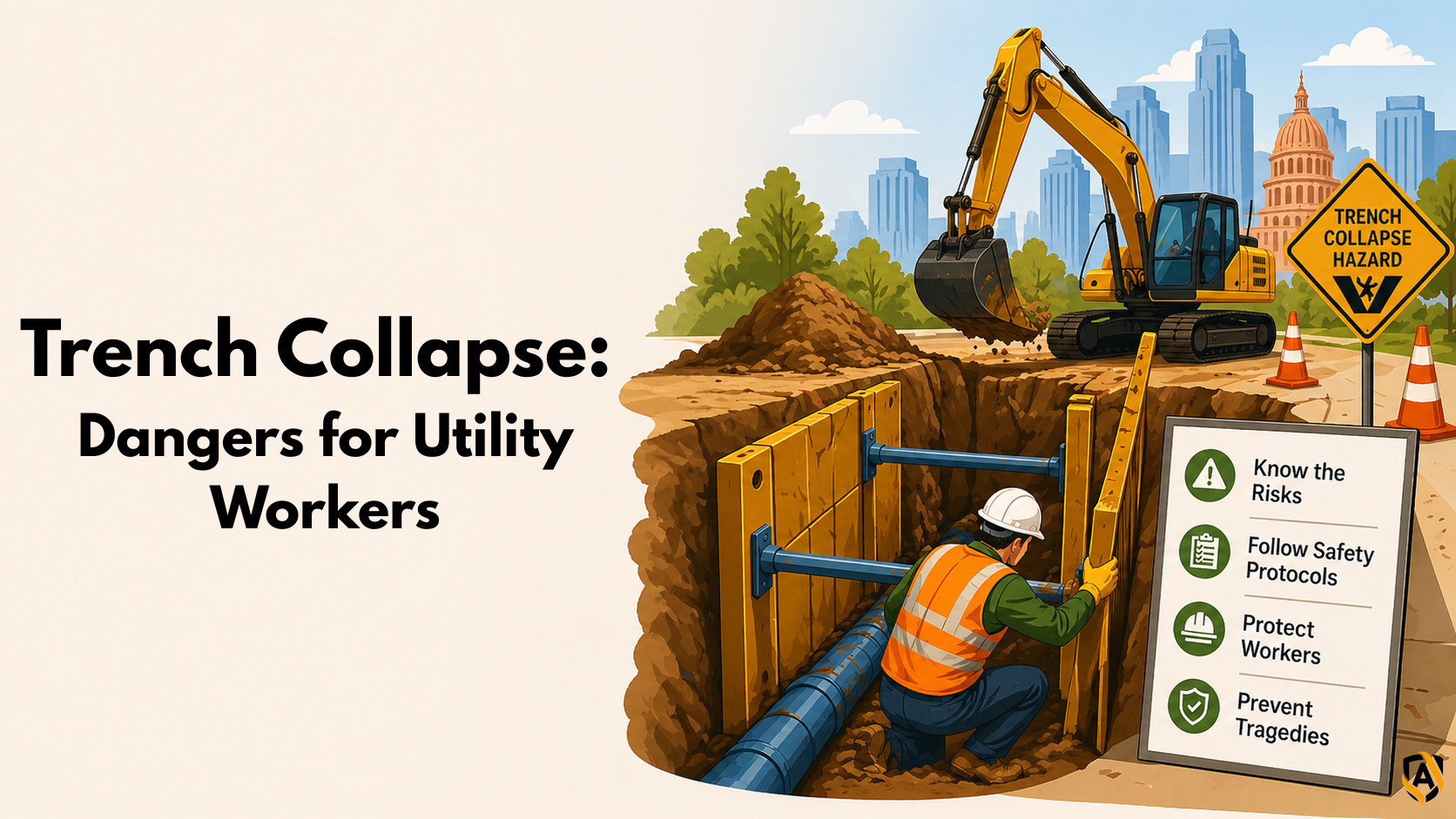
Trench Collapse: Dangers for Utility Workers
One cubic yard of soil weighs over 3,000 pounds-like a compact car crushing workers in seconds. From 2003 to 2017, 373 workers died in trenching operations, with 80% in construction.
However, these deaths are preventable. Worker fatalities dropped 70% from 2022 to 2024-from 39 deaths to 12-thanks to enhanced OSHA enforcement. This proves proper safety protocols save lives.
Understanding Trench Collapse Risks
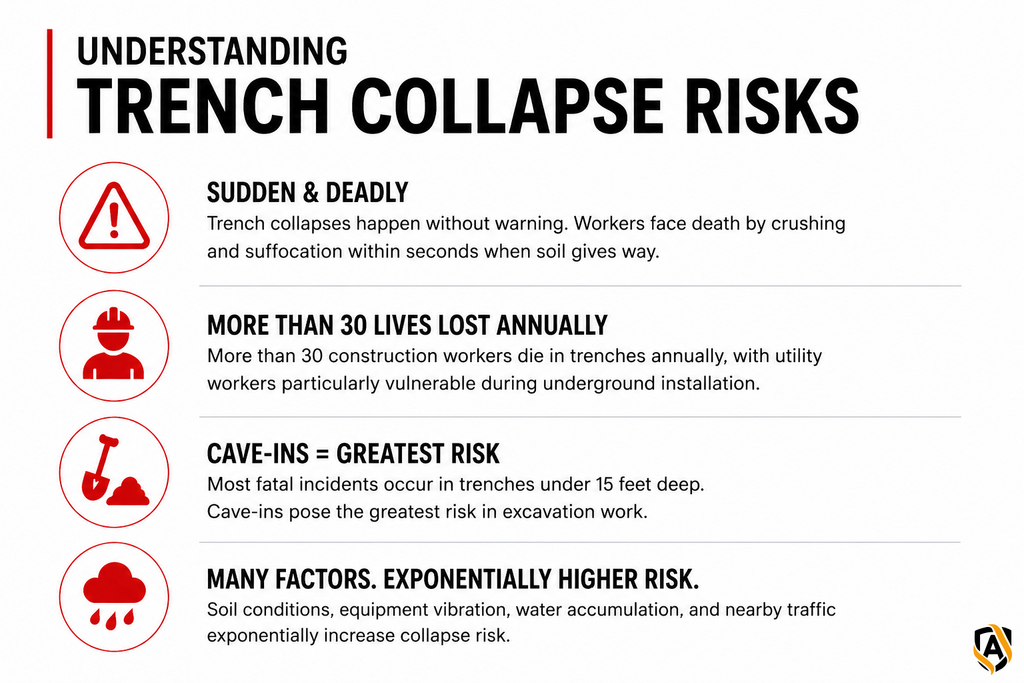
Trench collapses happen without warning. Workers face death by crushing and suffocation within seconds when soil gives way. More than 30 construction workers die in trenches annually, with utility workers particularly vulnerable during underground installation. Families affected by these workplace fatalities may pursue wrongful death claims against negligent employers.
Cave-ins pose the greatest risk in excavation work. Most fatal incidents occur in trenches under 15 feet deep. For workers injured but surviving these incidents, understanding Texas non-subscriber work injury claims becomes critical, as many utility companies opt out of traditional workers' compensation. Soil conditions, equipment vibration, water accumulation, and nearby traffic exponentially increase collapse risk.
OSHA Regulations and Legal Requirements
Three core standards govern trench safety: 29 CFR 1926.650 (definitions), 29 CFR 1926.651 (excavation requirements), and 29 CFR 1926.652 (protective systems).
Critical thresholds: 4 feet requires egress points, 5 feet requires protective systems, and 20 feet requires engineer-designed protections. Never enter a trench without proper inspection.
Recent penalties range from $796,000 to $1.8 million. OSHA pursues criminal referrals when negligence causes deaths. Injured workers navigating claims must also understand medical liens in Texas injury cases, which affect settlement amounts. In 2022, OSHA implemented "zero tolerance," conducting over 1,000 nationwide inspections.
Soil Classification and Safety Impact
OSHA classifies soil into three types based on compressive strength in tons per square foot.
Type A (strongest): 1.5+ tsf. Includes clay and silty clay. Maximum slope 3/4:1 (53°). Disqualified if fissured, vibrating, disturbed, or has seeping water.
Type B (medium): 0.5-1.5 tsf. Includes silt and angular gravel. Maximum slope 1:1 (45°).
Type C (weakest): Under 0.5 tsf. All granular soils. Any soil with seeping water is Type C. Maximum slope 1½:1 (34°)-the universal safe standard.
Competent persons must classify soil before excavation begins.
Protective Systems: Three Main Options
OSHA approves three protective methods: sloping, shoring, and shielding.
Sloping cuts walls at specific angles based on soil type. Requires no equipment but needs more space. The 1½:1 slope works for all soil types.
Shoring uses timber or hydraulic supports following manufacturer specs. Balances space and cost.
Shielding (trench boxes) employs steel/aluminum structures. Must extend 18 inches above ground. Workers prohibited inside during installation or movement.
Alternative trenchless methods-directional boring, pipe relining, tunneling-eliminate worker entry entirely.
Competent Person Requirements
Every trench needs a designated competent person-someone who identifies hazards and takes immediate corrective action.
No formal certifications required, but they need training in soil analysis, protective systems, and OSHA requirements. Daily duties include inspecting trenches, classifying soil, monitoring water removal, and authorizing worker evacuation when dangers appear.
Critical Safety Protocols
Specific thresholds prevent deaths:
- Access/egress: Ladders every 25 feet in trenches 4+ feet deep, extending 36 inches above surface
- Spoil piles: Minimum 2 feet from edge (measured from pile base)
- Atmospheric testing: Required at 4+ feet when oxygen drops below 19.5%
- Water management: Monitor removal equipment; evacuate during storms; inspect after rain
- Utilities: Call 811 before digging; maintain 5-foot clearance; companies respond within 24 hours
- Inspections: Before work, during shifts, after weather events
Decision Framework: Choosing Protection
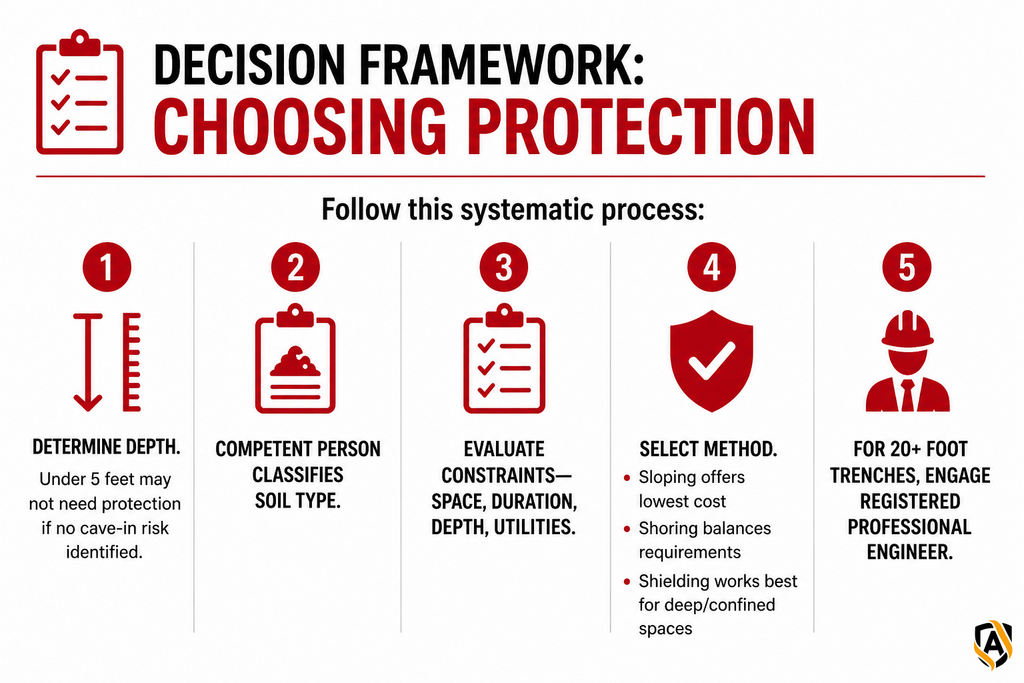
Follow this systematic process:
Step 1: Determine depth. Under 5 feet may not need protection if no cave-in risk identified.
Step 2: Competent person classifies soil type.
Step 3: Evaluate constraints-space, duration, depth, utilities.
Step 4: Select method. Sloping offers lowest cost; shoring balances requirements; shielding works best for deep/confined spaces.
Step 5: For 20+ foot trenches, engage registered professional engineer.
Consider trenchless alternatives to eliminate worker entry.
Preventing Trench Deaths
Trench deaths are preventable. The 70% fatality reduction proves enforcement and education work. Zero tolerance means violations bring substantial penalties and possible prosecution. Similar to construction zone crash liability, excavation site safety requires strict adherence to regulations.
Designate qualified competent persons, implement protective systems, conduct daily inspections, and prioritize safety over schedules. Every worker deserves to go home safely.
Frequently Asked Questions
At what depth does a trench require protective systems?
OSHA requires protective systems for trenches 5+ feet deep. Trenches 4+ feet trigger other requirements: ladders every 25 feet and atmospheric testing when hazards may exist. Even shallow trenches need protection if competent persons identify cave-in risks.
What qualifications does a competent person need?
No formal certifications required. They need training in soil analysis, protective systems, and OSHA requirements, plus ability to identify hazards and authority for immediate action including stopping work and evacuating workers.
Can I use the same protective system for all soil types?
Yes. OSHA's 1½:1 slope (34°) works for all soils. However, Type A (53°) and Type B (45°) allow steeper slopes, reducing excavation. Use soil-specific systems only after proper classification.
What are penalties for trench safety violations?
Recent OSHA penalties range from $796,000 to $1.8 million. Willful violations carry highest penalties. OSHA pursues criminal referrals when violations cause deaths. Common violations: no protective systems, inadequate training, missing inspections.
How quickly must utility companies respond to 811?
OSHA regulations require 24-hour response unless state law differs. "Response" means acknowledgment-actual marking takes additional days. Never excavate until all utilities are marked. Maintain 5-foot clearance to prevent collapses, electrocution, and explosions.
About the Author

Aaron B Mickens
For over 25 years, Aaron has fought for justice on behalf of Austin's injured. He is committed to standing up to insurance companies and winning for clients across Central Texas.
View all articles by AaronNeed Legal Help?
Contact our experienced Austin personal injury attorneys for a free consultation.