The Danger of Truck Blind Spots on Congested I-35: What Austin Drivers Must Know
In March 2025, a 17-vehicle crash on I-35 North Austin killed five people when an intoxicated semi-truck driver plowed into cars backed up in a construction zone. This marked the second deadly pileup in less than two weeks on Austin's deadliest corridor. I-35 through Austin ranks as the most congested section for truck traffic in Texas, carrying 244,450 vehicles daily with 30% truck traffic-higher than any other interstate in the state. With the I-35 Capital Express Project continuing through 2033, understanding truck blind spots has become critical for survival on Austin's roads.
Understanding Truck Blind Spots: The Federal "No-Zones"
To understand why crashes like this happen and how to prevent becoming a statistic yourself, you need to know exactly where these blind spots are. The Federal Motor Carrier Safety Administration (FMCSA) designates four "no-zones" where crashes are most likely to occur around commercial trucks.
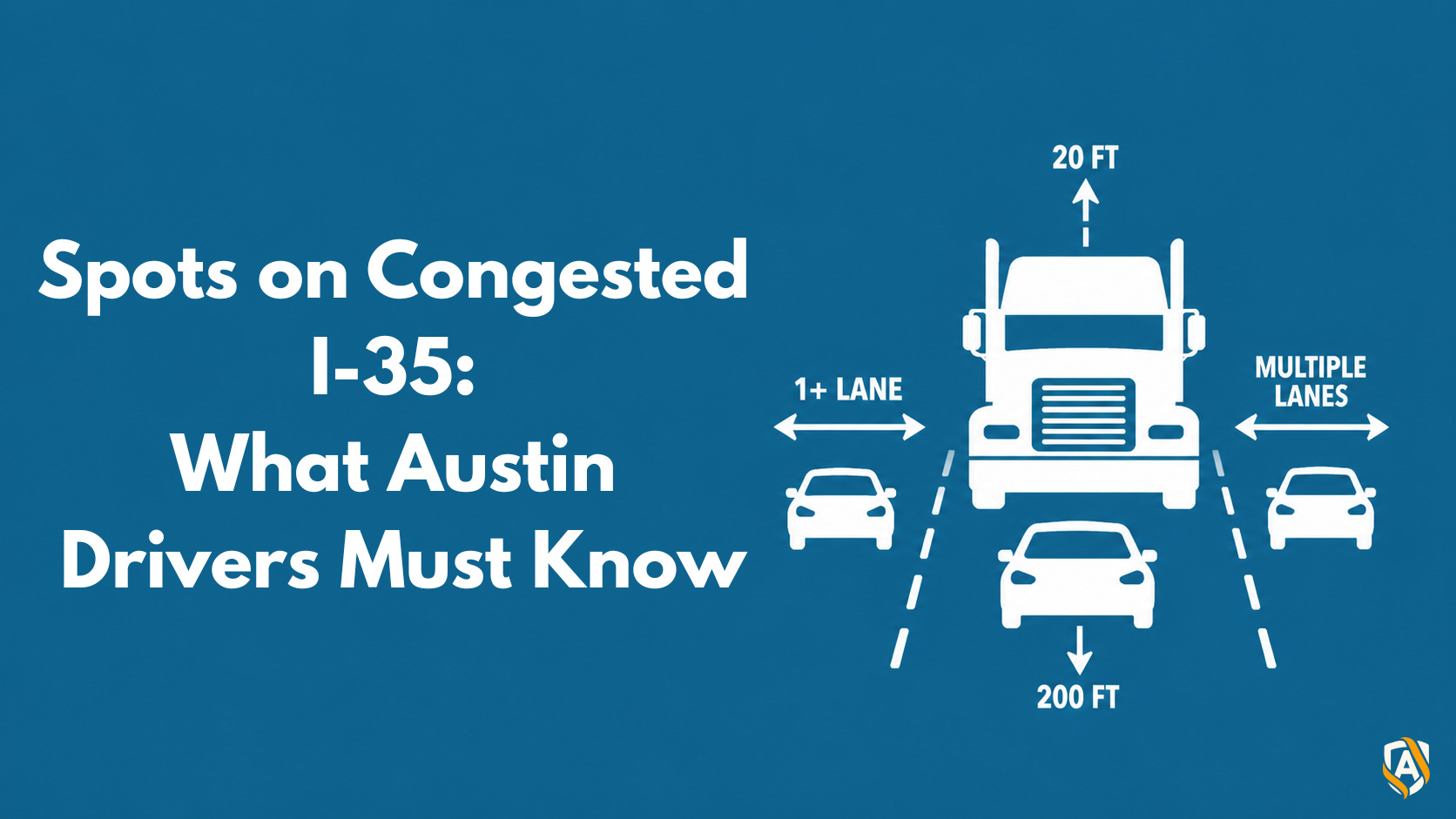
The front blind spot extends approximately 20 feet ahead of the truck due to elevated cabins that prevent drivers from seeing smaller vehicles directly below. The rear blind spot stretches up to 200 feet behind the truck-a vast area where your entire vehicle disappears from the driver's view. On the left side, the blind spot extends approximately one lane out from the truck. The right-side blind spot is the largest and most dangerous, spanning multiple lanes from the cab all the way to the trailer's end. These zones become even more treacherous when you consider that trucks require a 55-foot turning radius, often swinging wide into adjacent lanes during maneuvers.
Why I-35 Makes Blind Spot Accidents More Likely
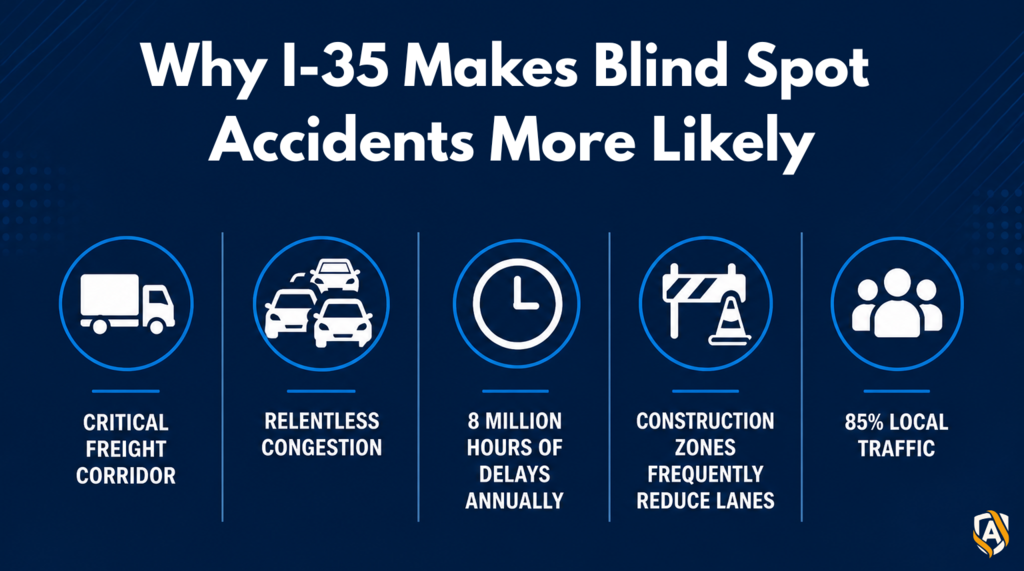
While these blind spots exist on every highway, I-35's unique characteristics multiply the risk exponentially. As a critical link in the international freight corridor connecting Laredo border crossings to the Midwest, I-35 experiences relentless truck traffic that's forecasted to increase 46% by 2040-a growth rate of 1.5% annually.
The congestion forces constant stop-and-go traffic, with trucks making continuous speed adjustments that significantly increase crash probability during high-volume periods. Drivers experience nearly 8 million hours of delays annually on the Austin stretch alone, generating a staggering $200 million in annual congestion costs-more than double Houston's Loop 610. Construction zones frequently reduce lanes, with the fatal March 2025 crash occurring where three lanes narrowed to just one. Compounding the danger, 85% of I-35 Austin traffic is local, creating a volatile mix of daily commuters navigating alongside long-haul truckers.
The Numbers Behind Blind Spot Crashes
The numbers confirm what Austin drivers already feel: I-35 is exceptionally dangerous. Approximately 300 people are killed annually in crashes directly attributable to truck blind spots nationwide. According to the FMCSA's Large Truck Crash Causation Study, one-third of all truck-passenger vehicle collisions occur in no-zones, with 14% of truck crashes caused by inadequate surveillance-meaning the driver simply failed to look.
The NHTSA's analysis of lane change crashes reveals that 42% of truck-involved crashes occur during merging scenarios, and 75% of lane-change/merge crashes involve driver recognition failure. On I-35 specifically, 2018 data documented 20,401 crashes resulting in 153 deaths and 471 serious injuries. Texas averages 98 commercial truck accidents per day-35,827 in 2023 alone.
Recent I-35 Fatal Incidents and Federal Investigation
These statistics aren't abstract-they represent real tragedies happening right now on Austin's I-35. The March 2025 disaster that killed five people occurred where three lanes reduced to one, prompting the National Transportation Safety Board to launch an investigation with construction work zone design as a "definite focus." This crash followed another deadly pileup just two weeks earlier.
TxDOT's queue warning system effectiveness has been questioned following these incidents. Work zone crashes remain persistent, with 2,791 work zone crashes on I-35 in 2018 alone, resulting in 19 fatalities and 59 serious injuries. Data from 2023-2025 shows no major decline in truck-related crash exposure, indicating the danger continues unabated as construction progresses.
Proven Safety Strategies for I-35 Drivers
While you can't control construction zones or truck driver vigilance, you can dramatically reduce your risk with these proven strategies. The FMCSA's primary safety rule is simple: if you can't see the truck driver's face in their side mirror, they can't see you.
Never linger beside trucks-the safest positions are ahead or behind, not alongside. When passing, do so quickly and completely, ensuring you see the driver in their mirror before merging back in front. Leave extra space when merging ahead of trucks; they require up to two football fields to stop safely. Right-side passing is particularly dangerous due to the largest blind spot spanning multiple lanes.
During lane reductions common in I-35 construction zones, stay especially alert for trucks changing lanes suddenly. Anticipate wide turns, remembering trucks need a 55-foot radius and may swing into adjacent lanes unexpectedly. Most importantly, avoid all distractions in high-congestion zones where split-second decisions mean the difference between safety and catastrophe.
Your Legal Rights After a Blind Spot Accident on I-35
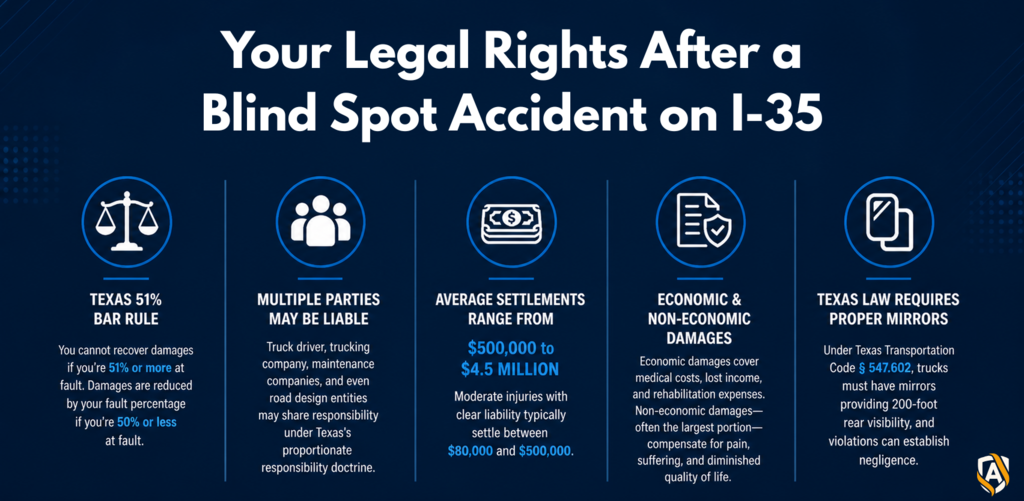
Despite your best efforts, if you are involved in a blind spot crash, understanding Texas law determines whether you can recover damages. Texas follows the 51% bar rule: you cannot recover damages if you're 51% or more at fault, and your damages are reduced by your fault percentage if you're 50% or less at fault.
Blind spot accidents often involve multiple liable parties. The truck driver may be liable for failing to check blind spots. The trucking company can be held vicariously liable for inadequate driver training or failure to enforce safety protocols. Maintenance companies and even road design entities may share responsibility. Texas's proportionate responsibility doctrine assigns fault to all at-fault parties.
Average settlements range from $500,000 to $4.5 million for serious injuries, with moderate injuries with clear liability typically settling between $80,000 and $500,000. Economic damages cover medical costs, lost income, and rehabilitation expenses, while non-economic damages-which often represent the largest portion-compensate for pain, suffering, and diminished quality of life. Under Texas Transportation Code § 547.602, trucks must have mirrors providing 200-foot rear visibility, and violations can establish negligence.
Protecting Yourself on Austin's Most Dangerous Road
Armed with this knowledge of both prevention and protection, you're prepared to navigate I-35 more safely and know your rights if the worst happens. I-35's unique combination of 30% truck traffic, severe congestion, and ongoing construction through 2033 makes blind spot awareness essential for every Austin driver.
Remember the four no-zones: 20 feet in front, 200 feet behind, one-plus lanes on each side. Apply the mirror visibility rule consistently-it's your simplest safety check. With 14% of truck crashes resulting from surveillance failures, your awareness protects you from driver error you can't control. Given the years of construction ahead, these defensive driving strategies will remain critical.
If you're involved in a blind spot crash, the Texas 51% rule makes fault determination crucial to your recovery. Contact an experienced truck accident attorney immediately to protect your rights and ensure proper investigation before evidence disappears.
Frequently Asked Questions
What are the exact dimensions of truck blind spots on I-35?
According to FMCSA measurements, truck blind spots extend 20 feet in front, up to 200 feet behind, approximately one lane on the left side, and multiple lanes on the right side-the most dangerous zone.
How many truck accidents happen annually on I-35?
In 2018, I-35 experienced 20,401 total crashes resulting in 153 deaths and 471 serious injuries. Construction zones accounted for 2,791 crashes with 19 fatalities and 59 serious injuries, according to TxDOT's I-35 Safety Campaign data.
Who is legally liable in a Texas truck blind spot accident?
Liability can fall on the truck driver for failing to check blind spots, the trucking company for inadequate training, or the passenger vehicle driver, depending on Texas's 51% comparative negligence determination. Multiple parties often share proportionate responsibility.
Does I-35 have more truck traffic than other Texas highways?
Yes. According to TxDOT corridor data, 30% of I-35 traffic consists of trucks-the highest percentage of any interstate in Texas-with truck VMT forecasted to increase 46% by 2040.
What should I do immediately after being hit by a truck in its blind spot?
Document the crash scene with photos, seek immediate medical attention even for minor symptoms, obtain the police crash report, and consult a truck accident attorney before giving recorded statements. The Texas 51% bar rule makes your fault percentage critical to recovery-early legal advice protects your rights.
About the Author

Aaron B Mickens
For over 25 years, Aaron has fought for justice on behalf of Austin's injured. He is committed to standing up to insurance companies and winning for clients across Central Texas.
View all articles by AaronNeed Legal Help?
Contact our experienced Austin personal injury attorneys for a free consultation.