Marina Slip and Fall Rights: Maritime Law Guide 2026
Marina workers face significant dangers. The CDC reports water transportation workers have a fatality rate 4.7 times higher than all U.S. workers. Falls and drowning are the second leading cause of longshoring deaths per OSHA data. Legal rights after marina slip and falls involve complex jurisdictional questions. Compensation depends on worker classification, accident location, and whether maritime or state law applies. Different frameworks protect seamen (Jones Act), dock workers (LHWCA), and visitors (premises liability).
Understanding Legal Jurisdiction: Maritime Law vs. State Law
Identifying which legal system governs your claim is critical. Maritime law applies to vessel-connected incidents and workers performing vessel-related duties; state law governs land-based property liability for visitors. Dock workers loading vessels fall under maritime law, while recreational boaters pursue state premises liability claims. Fall location-vessel, gangway, dock, or pier-determines applicable standards. State legal standards vary considerably in duty of care requirements. This affects available compensation and claim procedures.
Federal Safety Standards & Regulations
Federal regulations establish specific marina safety requirements. OSHA's 29 CFR 1917.12 requires employers eliminate slippery conditions in work areas. Gangway safety under 29 CFR 1918.22 mandates 20-inch minimum width, 33-inch handrails with midrails, five foot-candle illumination, and maximum 30-degree angles. Handrails and walking surfaces must be maintained to prevent slipping.
Property owners must install guardrails at waterside edges with fall exposure over four feet, meeting 42-inch height requirements under 29 CFR 1917.112. Housekeeping standards prohibit debris and obstructions in active areas, similar to uneven sidewalk liability standards. The 2010 ADA Standards require accessible routes to boat slips. Violations of these standards strengthen premises liability claims.
Common Hazards at Marina Docks
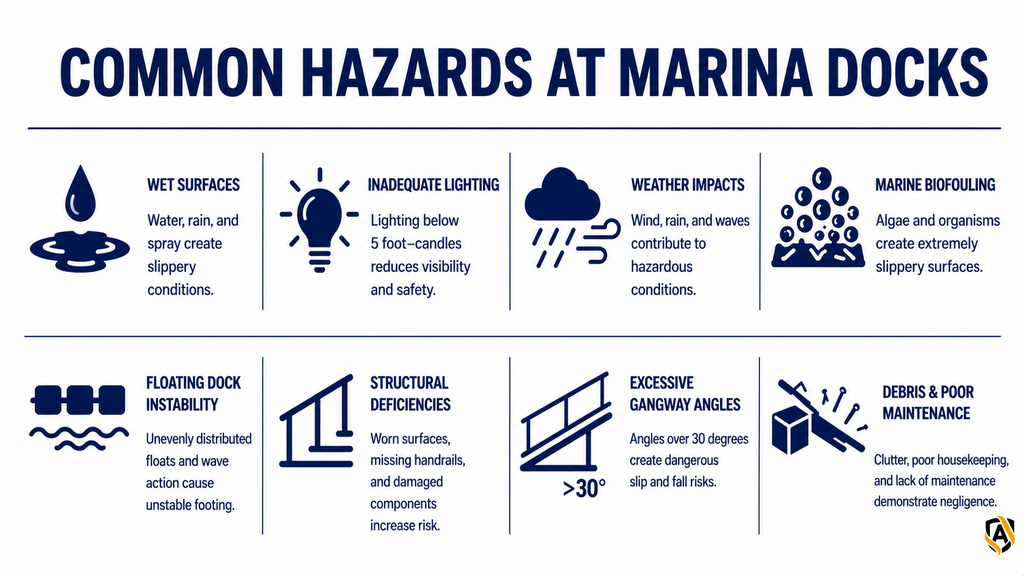
Marina accidents result from environmental, structural, and maintenance hazards. Environmental conditions include wet surfaces, inadequate lighting below five foot-candles, weather impacts, and marine biofouling creating slippery surfaces. Floating dock instability-from unevenly distributed floats and wave action-creates unstable footing. Structural deficiencies include worn surfaces, missing handrails, and debris. Gangway angles exceeding 30 degrees present dangers. Maintenance failures demonstrate negligence. ASTM standards recommend 0.42 dynamic coefficient of friction.
Worker Protection: Jones Act and LHWCA Coverage
Federal law provides two frameworks for maritime workers. The Jones Act covers seamen with substantial vessel employment connections-30 percent or more time on vessels. It allows negligence and unseaworthiness claims beyond workers' compensation. The Longshore and Harbor Workers' Compensation Act covers dock workers, ship repairmen, and builders not qualifying as seamen, offering different protections than Texas non-subscriber work injury claims. LHWCA requires both "status" and "situs" (work on navigable waters or adjoining areas). Benefits include two-thirds wage during treatment, then awards or wage loss compensation.
Premises Liability & Property Owner Duty
State premises liability law governs non-maritime worker accidents. Commercial marina operators owe the highest duty of care, protecting visitors from known or discoverable hazards, similar to swimming pool accident liability. Potentially liable parties include marina owners, manufacturers, contractors, or third parties. Texas applies modified comparative negligence with a 51 percent bar-no recovery if fault exceeds 50 percent. Compensation is reduced proportionally to fault percentage.
Decision Framework: Determining Your Legal Rights
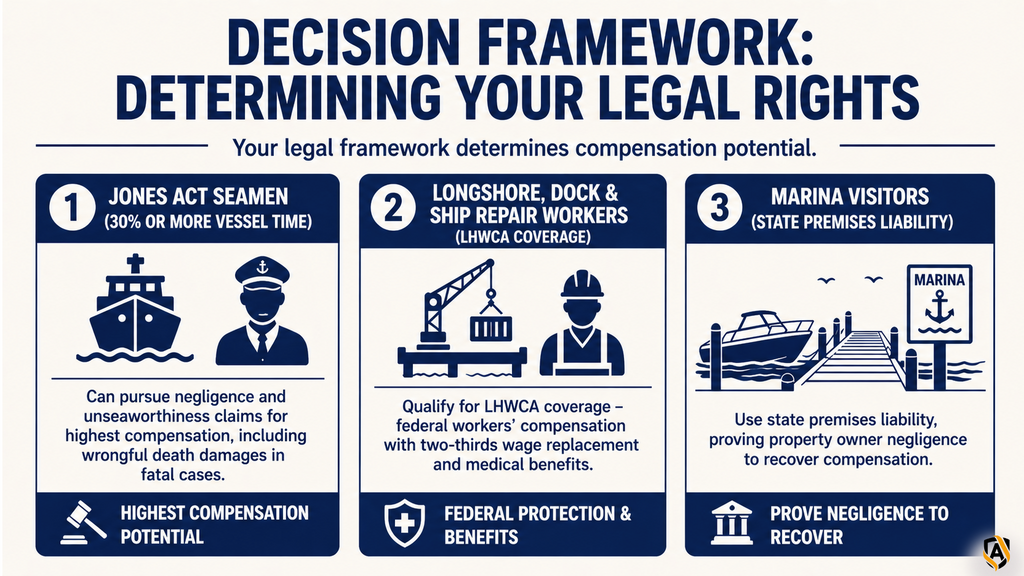
Your legal framework determines compensation potential. Jones Act seamen (30 percent or more vessel time) can pursue negligence and unseaworthiness claims for highest compensation, including wrongful death damages in fatal cases. Longshore, dock, and ship repair workers qualify for LHWCA coverage-federal workers' compensation with two-thirds wage replacement and medical benefits. Marina visitors use state premises liability, proving property owner negligence. Compensation may be reduced by comparative fault and affected by medical liens.
Conclusion
Marina slip and fall accidents involve complex jurisdictional questions requiring specialized expertise. Worker classification determines applicable frameworks and potential recovery. Federal OSHA maritime standards establish baseline requirements; violations strengthen claims. Document the scene immediately-photograph hazards, obtain witness information, preserve evidence. Understanding the settlement negotiation timeline helps set realistic expectations. Consult a maritime law attorney specializing in Jones Act, LHWCA, or admiralty law within your statute of limitations, or a wrongful death attorney for fatal accidents.
Frequently Asked Questions
What's the difference between Jones Act and LHWCA coverage?
Jones Act covers seamen (30%+ vessel time) with negligence and unseaworthiness claims beyond workers' comp. LHWCA covers dock workers, ship repairmen, and longshore workers not qualifying as seamen, providing federal workers' comp with two-thirds wage replacement. Jones Act offers higher compensation potential.
Can marina visitors injured in slip and falls sue under maritime law?
No. Maritime law doesn't apply to recreational visitors. They pursue state premises liability claims proving property owner negligence. Unlike maritime protections, claims are subject to comparative negligence rules reducing compensation based on fault percentage.
What OSHA violations commonly contribute to marina slip and fall accidents?
Common violations: failure to eliminate slippery conditions (29 CFR 1917.12), inadequate gangways (29 CFR 1918.22), missing guardrails (29 CFR 1917.112), insufficient lighting, and poor housekeeping (29 CFR 1917.11). Documenting violations strengthens claims.
How does comparative negligence affect my slip and fall claim?
States apply comparative negligence reducing compensation by fault percentage. Texas uses a 51 percent bar-over 50 percent at fault means no recovery. If 30 percent responsible, compensation drops 30 percent. Courts consider distraction and ignoring warnings.
How long do I have to file a marina slip and fall claim?
Deadlines vary by claim type and state. Jones Act claims typically allow three years, LHWCA requires filing within one year. State premises liability statutes range from one to six years. Missing deadlines permanently bars claims.
About the Author

Aaron B Mickens
For over 25 years, Aaron has fought for justice on behalf of Austin's injured. He is committed to standing up to insurance companies and winning for clients across Central Texas.
View all articles by AaronNeed Legal Help?
Contact our experienced Austin personal injury attorneys for a free consultation.