Mild TBI Legal Rights: When to Seek Disability Benefits
The term "mild" traumatic brain injury misleads many victims. Of the 214,110 TBI-related hospitalizations occurring annually from car accidents, motorcycle crashes, truck collisions, and slip and fall incidents, 75-80% receive a "mild" classification based on initial consciousness levels, not long-term impact. Healthcare providers use "mild" to indicate the injury isn't immediately life-threatening, even though effects can be serious.
Today, 5.3 million Americans live with TBI-related disabilities, many from injuries initially classified as mild. For legal purposes—whether pursuing disability benefits or personal injury compensation—functional impact matters more than medical severity labels.
Understanding TBI Classification: Medical vs. Legal Reality
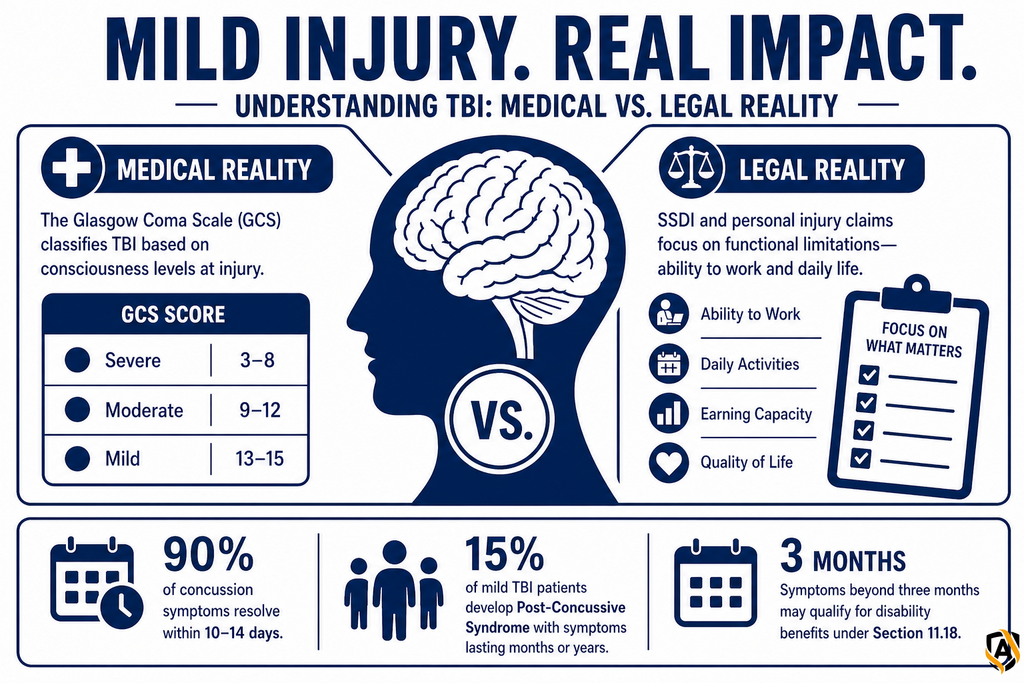
The Glasgow Coma Scale (GCS) classifies TBI as severe (3-8), moderate (9-12), or mild (13-15) based on consciousness levels at injury. This emergency triage system measures immediate status, not disability potential.
Social Security Disability Insurance (SSDI) evaluates functional limitations—your ability to work and manage daily tasks. Personal injury claims similarly focus on earning capacity and quality of life impacts. A GCS score of 13-15 might label your injury "mild," but persistent symptoms beyond three months may qualify you for disability benefits under Section 11.18.
While 90% of concussion symptoms resolve within 10-14 days, 15% of mild TBI patients develop Post-Concussive Syndrome with symptoms lasting months or years.
The "Invisible" Nature of Mild TBI: Why It's Hard to Prove
Mild TBI often leaves no trace on standard imaging. You can have normal CT and MRI results despite significant cognitive impairment. CT scans detect structural damage requiring emergency surgery but miss axonal injuries—microscopic nerve fiber tearing causing lasting cognitive problems.
MRI proves more sensitive for these injuries 24-48 hours post-trauma, yet even advanced MRI may appear normal while you struggle with memory and concentration. Emerging blood biomarkers like GFAP and S-100B show diagnostic promise but aren't yet routine in legal proceedings.
For disability examiners and insurance adjusters, this invisibility means higher burden of proof. Your symptoms are self-reported, cognitive deficits subtle but functionally limiting. Strategic documentation becomes essential.
Long-Term Consequences: When "Mild" Becomes Chronic
Memory and attention deficits represent common consequences. Research shows impaired working memory, distractibility, and affected executive functions following mild TBI, translating to real employment problems.
Each year, 80,000-90,000 Americans develop long-term disability from TBI. Post-Concussive Syndrome affects 15% of mild TBI patients, with symptoms persisting three months or longer. Common symptoms include headache, fatigue, vision changes, balance issues, insomnia, and neuropsychiatric effects.
Cognitive impairment duration varies by age, education, socioeconomic status, and previous TBI history. You might remain employable but at reduced capacity—working part-time, handling simpler tasks, or requiring accommodations limiting career advancement. The three-month mark becomes legally significant—when PCS criteria are met and Social Security requires evidence for TBI disability evaluation.
High-Risk Populations: When Mild TBI Becomes Catastrophic
Second Impact Syndrome—though rare—carries 50-100% mortality rates when athletes return to play within 10-15 days post-concussion, potentially leading to wrongful death claims. The CDC estimates 1.6-3.8 million sports-related concussions occur annually. Bicycle and pedestrian accidents also cause significant TBI cases. Repeated concussions contribute to Chronic Traumatic Encephalopathy (CTE)—a progressive condition where non-concussive impacts may drive pathology.
Military veterans face elevated risks. Over 485,500 service members received TBI diagnoses between 2000-2023, with 80% classified as mild blast TBI. Nearly half reported post-concussive symptoms three months post-deployment.
For youth, about 6.9% aged 5-17 sustained sports-related TBI in the preceding year. Developing brains show greater vulnerability to long-term impacts.
Legal Rights and Disability Benefits: What You're Entitled To
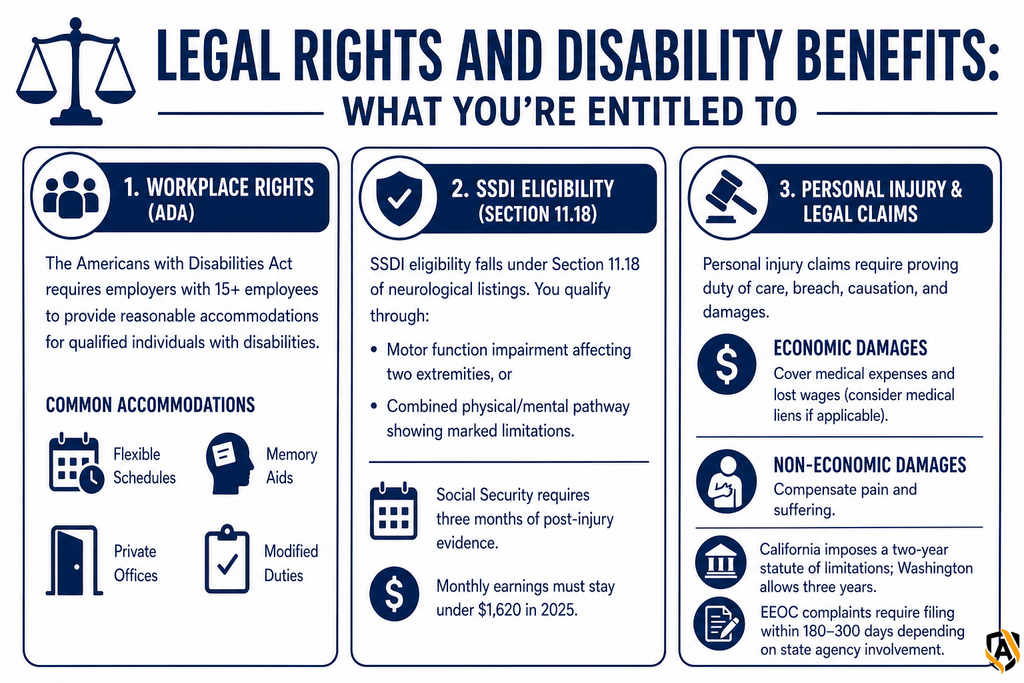
The Americans with Disabilities Act requires employers with 15+ employees to provide reasonable accommodations for qualified individuals with disabilities. Common accommodations include flexible schedules, memory aids, private offices, and modified duties.
SSDI eligibility falls under Section 11.18 of neurological listings. You qualify through motor function impairment affecting two extremities, or combined physical/mental pathway showing marked limitations. Social Security requires three months of post-injury evidence. Monthly earnings must stay under $1,620 in 2025.
Personal injury claims require proving duty of care, breach, causation, and damages. Economic damages cover medical expenses and lost wages (consider medical liens if applicable); non-economic damages compensate pain and suffering. California imposes a two-year statute of limitations; Washington allows three years. EEOC complaints require filing within 180-300 days depending on state agency involvement.
Decision Framework: Should You Consult a Lawyer?
Symptoms persisting beyond three months reach the PCS threshold and SSDI eligibility window. Inability to return to previous work capacity suggests potential disability claims.
Documentation challenges trigger consultation needs: employer denying accommodations, insurance disputing causation, or medical providers downplaying symptoms. Multiple potentially liable parties—vehicle operators, property owners, employers, sports organizations—increase claim complexity.
Athletes or workers sustaining second concussions within vulnerability windows need immediate evaluation. Veterans access a separate VA disability system with different standards—many qualify for both VA and civilian SSDI.
Consider this: severe TBI with full recovery may prove less disabling than mild TBI with persistent PCS. Legal evaluation focuses on functional impact, not initial classification. The question isn't whether your injury was "mild" medically, but whether it prevents you from living and working as before.
Statutes of limitations run from injury date. Evidence grows stale—witnesses' memories fade, medical records become harder to obtain. Early consultation preserves claim options while documentation remains fresh.
Conclusion
Medical classifications serve emergency triage, not legal evaluation. Fifteen percent of mild TBI cases develop chronic disability, affecting 80,000-90,000 Americans annually. If symptoms persist three months post-injury, consult an attorney to assess eligibility.
Documentation proves critical for invisible injuries where imaging appears normal despite impairment. Don't let the "mild" label deter legal evaluation—functional limitations, not GCS scores, determine your rights.
Frequently Asked Questions
Can I get disability benefits for a "mild" TBI?
Yes, if symptoms persist three months or longer causing functional limitations. SSDI evaluates your inability to work and perform daily activities, not medical severity classification. Fifteen percent of mild TBI patients develop Post-Concussive Syndrome with chronic symptoms qualifying for benefits under Section 11.18.
Will a normal CT scan hurt my disability or injury case?
No. Axonal injuries causing cognitive impairment often remain invisible on standard CT scans. MRI proves more sensitive 24-48 hours post-trauma. Your medical history, neuropsychological testing, and functional assessments carry more weight than a single normal CT scan.
How long do I have to file after TBI?
Timeframes vary by claim type. SSDI applications have no strict deadline but require three months of post-injury evidence. Personal injury lawsuits face state-specific statutes—California allows two years, Washington three years. ADA employment complaints require EEOC filing within 180-300 days.
What if I was partially at fault for my TBI accident?
Comparative negligence states like California and Washington allow partial recovery based on fault percentages. If you're 30% at fault, you recover 70% of damages. Some states follow contributory negligence rules barring any recovery if you share fault—consult an attorney understanding your state's laws.
Should I accept a quick insurance settlement after mild TBI?
No. Consult an attorney before accepting any settlement. TBI symptoms often appear or worsen weeks to months after injury. Insurance companies offer quick settlements before full injury extent becomes apparent. Once you sign a release, you typically cannot pursue additional compensation if symptoms persist or worsen later.
About the Author

Aaron B Mickens
For over 25 years, Aaron has fought for justice on behalf of Austin's injured. He is committed to standing up to insurance companies and winning for clients across Central Texas.
View all articles by AaronNeed Legal Help?
Contact our experienced Austin personal injury attorneys for a free consultation.