Motorcycle Passenger Rights in Texas Injury Claims 2026
Texas recorded 581 motorcycle fatalities in 2024 with 2,534 serious injuries, but only 6% of deaths were passengers according to TxDOT crash data. Passengers have almost no control over motorcycle operation, making them rarely at fault under Texas comparative negligence law. Texas requires mandatory guest passenger liability coverage on all motorcycle accident policies specifically to protect injured passengers.
Passenger Liability: Why You're Rarely at Fault
Texas follows modified comparative negligence with a 51% bar rule under Texas Civil Practice & Remedies Code § 33.001. You cannot recover damages if your fault exceeds 50%. However, passengers rarely control motorcycle operation, making fault assignment extremely rare. When assigned 0% fault, passengers recover 100% of damages.
Understanding how fault is determined in Texas is critical. You can pursue claims against the motorcycle operator, other drivers, or both simultaneously.
Texas Insurance Requirements for Motorcycle Passengers
Texas requires mandatory coverage with minimum limits of $30,000/$60,000/$25,000 according to the Texas Department of Insurance. Guest passenger liability is specifically designed to cover passenger injuries.
Understanding who pays medical bills after an accident is important. Optional MedPay coverage provides immediate payment but is subject to subrogation, meaning medical liens can affect your settlement.
Optional UM/UIM coverage is highly recommended given Texas's 14.5% uninsured motorist rate. Texas Insurance Code § 1952.101(b) requires insurers to offer UM/UIM coverage unless explicitly rejected in writing.
All passengers under age 21 must wear helmets per Texas Transportation Code § 661.003. Those 21+ are exempt if the operator completed a safety course. Helmets are 41% effective in preventing passenger fatalities according to NHTSA safety data.
Multiple Insurance Sources Available to Passengers
Passengers can file claims against multiple policies simultaneously: the other driver's auto liability insurance, the motorcycle operator's guest passenger liability coverage, and your personal UM/UIM coverage even when not driving.
Third-party liability claims extend to government entities for dangerous road conditions or manufacturers for defective parts. Joint and several liability applies when a defendant exceeds 50% fault under Texas Civil Practice & Remedies Code § 33.013, allowing full damage collection from that party.
Compensation Types and Settlement Ranges
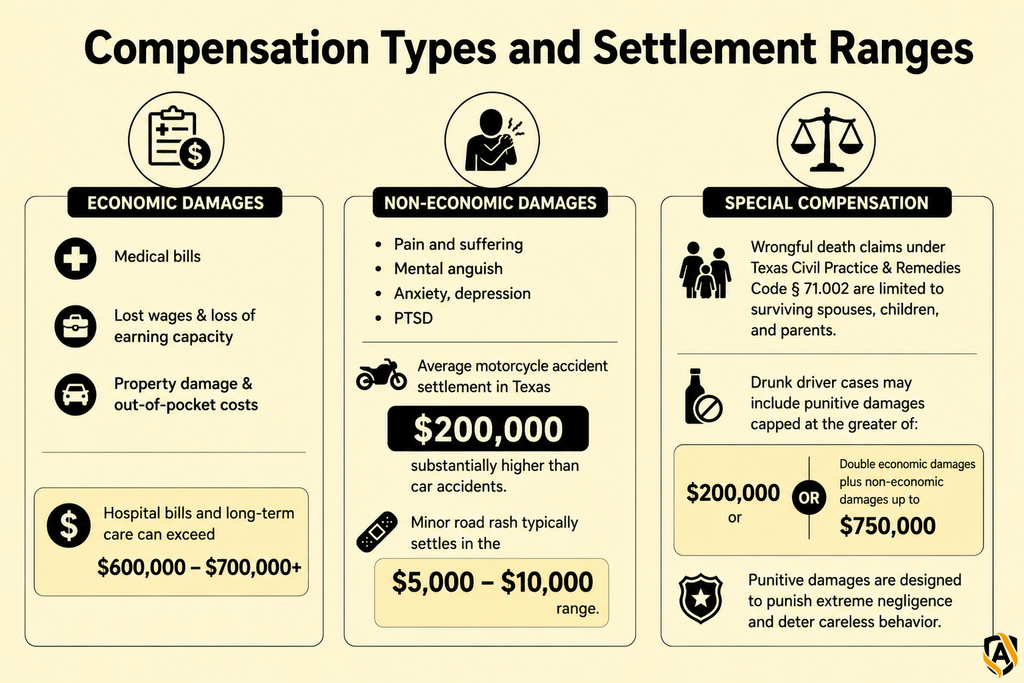
Economic damages include medical bills, lost wages, loss of earning capacity, and out-of-pocket costs. Property damage claims for damaged belongings are available. Hospital bills and long-term care can exceed six or seven figures.
Non-economic damages compensate for pain and suffering, mental anguish, anxiety, depression, and PTSD. The average motorcycle accident settlement in Texas is approximately $200,000, substantially higher than car accidents. Minor road rash typically settles in the $5,000-$10,000 range.
Wrongful death claims under Texas Civil Practice & Remedies Code § 71.002 are limited to surviving spouses, children, and parents. Drunk driver cases may include punitive damages capped at the greater of $200,000 or double economic damages plus non-economic damages up to $750,000.
Special Liability Situations
Drunk driver liability insurance must cover passenger injuries even when the operator was intoxicated. Civil claims are possible even without criminal conviction. However, minimum coverage often provides only $30,000 for injuries.
Product liability claims for defective parts use a strict liability standard. Common defects include brake failure, tire blowouts, and engine malfunctions. Preserve the motorcycle without repairs for evidence.
Negligent entrustment holds motorcycle owners liable if they lent the bike to an unlicensed, incompetent, or reckless person they knew or should have known was unqualified.
Critical Evidence and Timeline Requirements
Seek immediate medical attention. The police report (CR-3) lists your name, seating position, injuries, and safety equipment use. Obtain your copy through TxDOT's Crash Report Online Purchase System.
Photograph injuries, vehicle positions, damage, and road conditions immediately. Gather the other driver's contact, license plate, and insurance details. Notify all insurance companies immediately.
The two-year statute of limitations runs from the accident date. Minors have until their 20th birthday. Wrongful death claims allow two years from the death date. Missing these deadlines permanently bars compensation.
Decision Framework: Your Action Plan
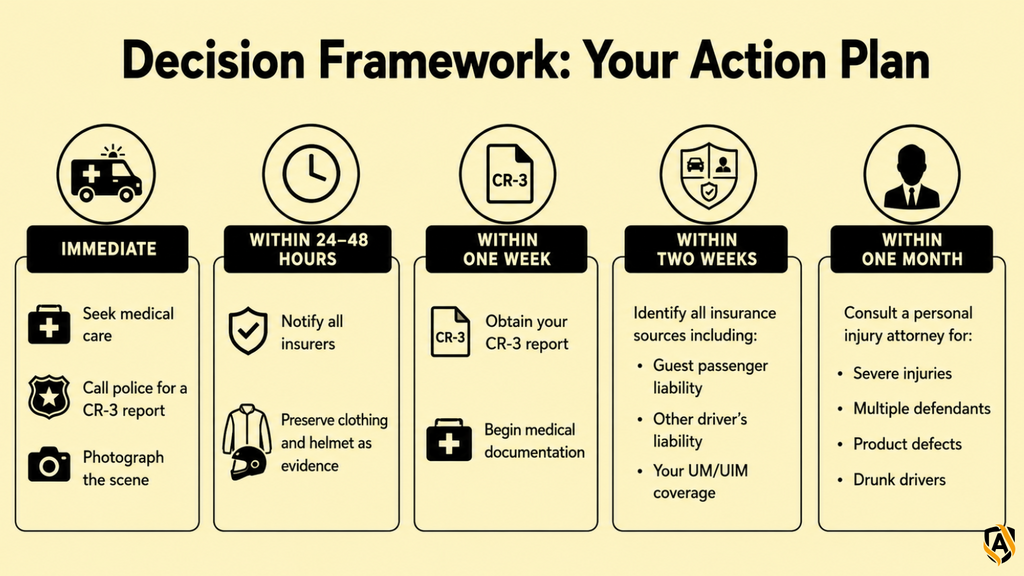
Immediate: Seek medical care, call police for a CR-3 report, and photograph the scene. Within 24-48 hours: Notify all insurers and preserve clothing and helmet as evidence.
Within one week: Obtain your CR-3 report and begin medical documentation. Within two weeks: Identify all insurance sources including guest passenger liability, other driver's liability, and your UM/UIM.
Within one month: Consult a personal injury attorney for severe injuries, multiple defendants, product defects, or drunk drivers. Understanding the settlement negotiation timeline helps set realistic expectations.
Frequently Asked Questions
Can I sue the motorcycle operator who was driving when I got injured?
Yes. The operator's mandatory guest passenger liability coverage handles claims through their insurance policy rather than personal lawsuits.
What if the at-fault driver doesn't have enough insurance?
Use your own UM/UIM coverage even though you weren't driving. If the operator exceeds 50% liability, joint and several liability allows full damage collection. Consider product liability or negligent entrustment claims.
Will my pre-existing injury prevent compensation?
No. Texas's "eggshell plaintiff" rule protects victims with pre-existing conditions. The at-fault party remains responsible for aggravation damages, as affirmed in Leitch v. Hornsby, 935 S.W.2d 114 (Tex. 1996).
How long do I have to file a claim?
Texas provides a two-year statute of limitations from the accident date under Texas Civil Practice & Remedies Code § 16.003. Minors have until their 20th birthday. Wrongful death claims allow two years from the death date.
Do I need to wear a helmet as a passenger?
Passengers under 21 must wear helmets by law. Those 21+ are exempt if the operator completed a safety course. Helmets are 41% effective at preventing passenger fatalities per NHTSA research. Non-use may reduce damages under comparative negligence.
About the Author

Aaron B Mickens
For over 25 years, Aaron has fought for justice on behalf of Austin's injured. He is committed to standing up to insurance companies and winning for clients across Central Texas.
View all articles by AaronNeed Legal Help?
Contact our experienced Austin personal injury attorneys for a free consultation.